
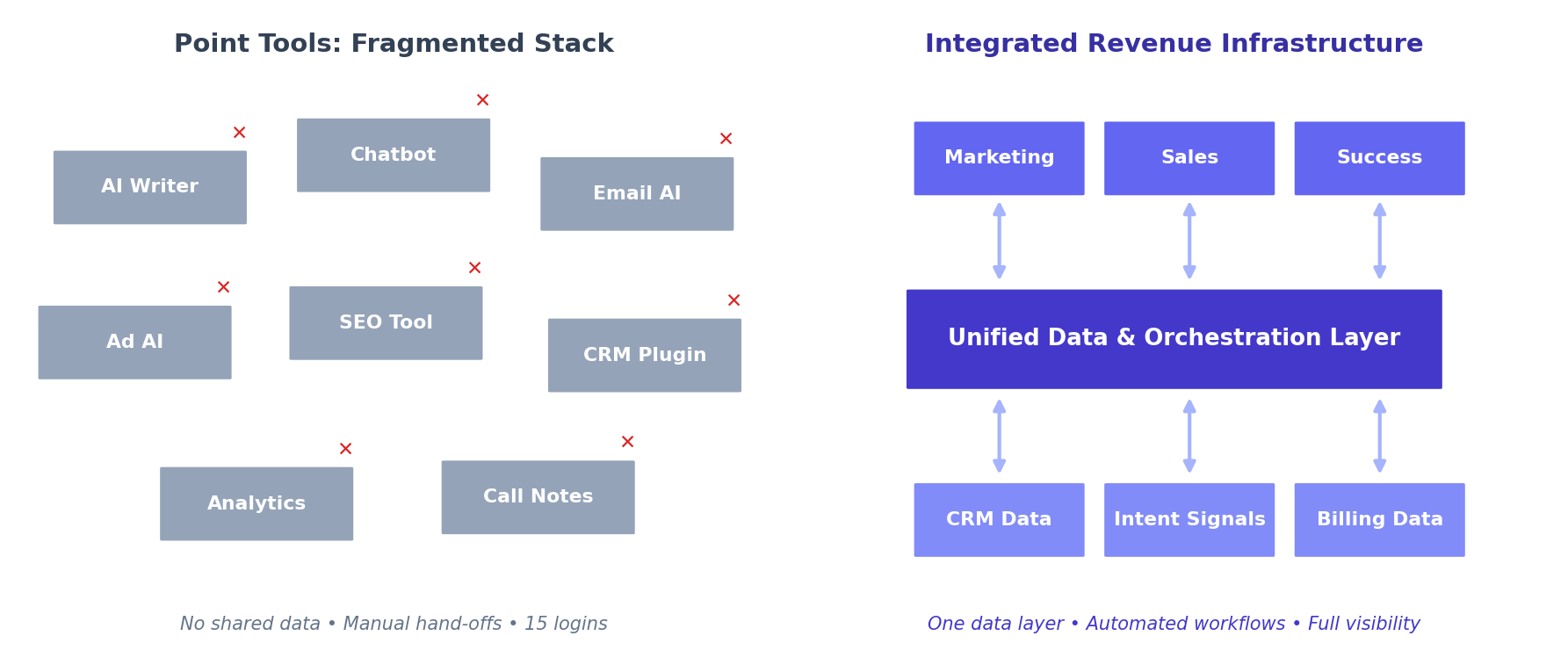
Walk into any modern revenue team and count the AI tools. You will probably find fifteen or more. There is an AI writer for emails. A chatbot for the website. A plugin for call notes. Another tool for ad copy. Each one promised to save time. Together, they are quietly breaking your operations.
This is the point tool trap. Companies keep buying isolated AI apps to fix isolated problems. But revenue is not an isolated problem. It is one connected journey. When your AI tech stack is a pile of disconnected subscriptions, that journey gets sliced into fragments. The fix is not another tool. It is a unified revenue automation infrastructure.
The Point Tool Trap: How AI Tool Sprawl Happens
Nobody plans to build a fragmented stack. It happens one purchase at a time. Marketing buys an AI content tool. Sales adds an AI dialer. Customer success signs up for an AI summary app. Each decision looks smart on its own.
Six months later, the company paid for fifteen subscriptions. Every tool has its own login, its own settings, and its own version of the customer. None of them talk to each other. This is AI tool sprawl, and it is now the default state of most mid-market tech stacks.
The problem is structural. Point tools are built to win one task, not to run your business. They optimize for a demo, not for a workflow. The moment a task needs context from another system, the tool hits a wall. And your team becomes the integration layer, copying and pasting data between apps.
Fragmented Workflows and Data Silos: The Real Cost
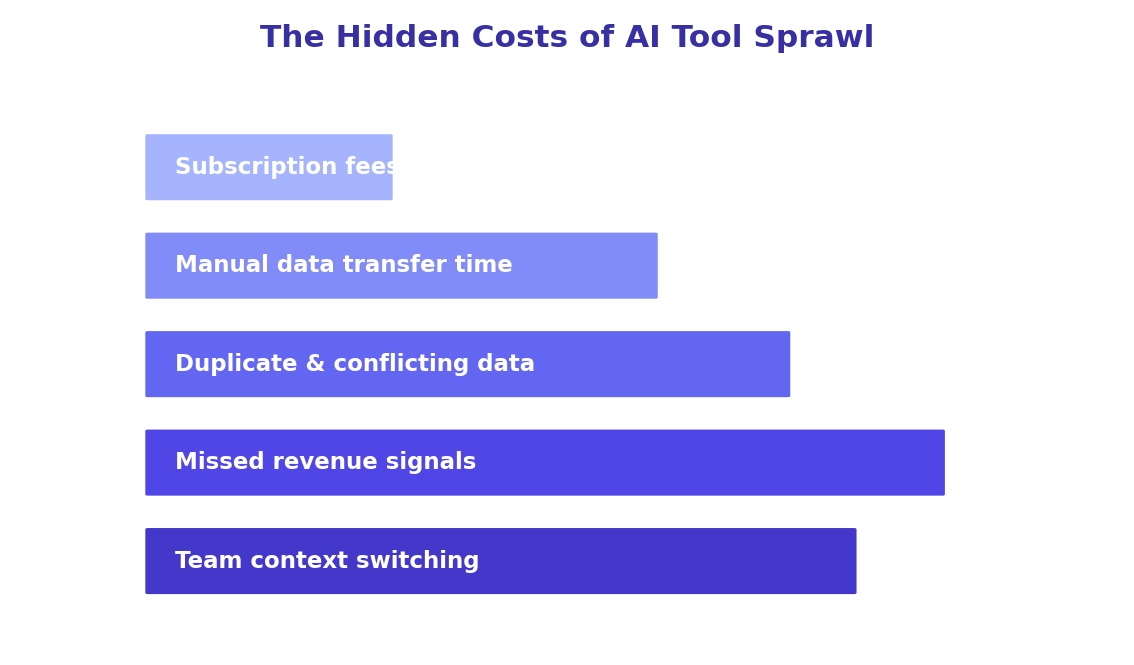
Disconnected tools do not just waste money on subscriptions. They create data silos that damage revenue in ways that never show up on an invoice.
Consider a simple example. Your AI chatbot qualifies a lead on Tuesday. Your AI email tool sends that same lead a cold "nice to meet you" sequence on Wednesday, because it has no idea the conversation happened. The lead feels ignored. The deal dies. No dashboard ever reports why.
Multiply that across every hand-off. Marketing data never reaches sales. Sales conversations never inform success. Billing signals never trigger expansion plays. Each silo hides revenue signals that an integrated system would catch automatically. Analysts call this the fragmentation tax, and it compounds every quarter.
Why More AI Makes Fragmentation Worse
Here is the uncomfortable truth. AI amplifies whatever structure it sits on. On clean, unified data, AI compounds your advantage. On fragmented data, AI compounds your chaos. Fifteen smart tools working from fifteen partial pictures produce fifteen confident, conflicting answers.
This is why teams often feel less productive after adopting AI. The tools are fine. The infrastructure underneath them is failing.
What Integrated Revenue Automation Infrastructure Looks Like
Integrated infrastructure flips the model. Instead of buying AI as scattered plugins, you build AI into the foundation of your revenue engine. Three things define this approach.
First, a unified data layer. Every workflow, from first touch to renewal, reads and writes to the same customer record. When the chatbot qualifies a lead, the email system knows instantly. There is one version of the truth.
Second, orchestrated workflows. AI agents do not just complete tasks. They trigger each other. A pricing page visit can score the account, alert the owner, and draft a tailored follow-up in one automated chain. This is marketing workflow automation operating at the infrastructure level, not the plugin level.
Third, full-funnel visibility. Because everything runs on one system, you can finally see which actions drive revenue. Attribution stops being a guessing game across fifteen exports.
Why This Is the Collide Approach
This is exactly the philosophy behind Collide. Rather than selling another disconnected AI plugin, Collide helps companies build unified revenue automation infrastructure. The goal is simple: one connected system where data, AI agents, and human teams operate on shared context. You stop paying the fragmentation tax and start compounding every signal you capture.
Point Tools vs. Integrated Infrastructure: A Side-by-Side View
The difference becomes obvious when you compare the two models directly. Point tools give you speed on single tasks. Integrated infrastructure gives you speed across the entire revenue journey.
With point tools, onboarding a new campaign means configuring five apps and praying the exports line up. With integrated infrastructure, it means describing the workflow once and letting the system orchestrate it. With point tools, a churn signal lives inside one dashboard nobody checks. With integrated infrastructure, that signal automatically launches a retention play.
Cost tells the same story. Fifteen subscriptions at modest prices often exceed the cost of one unified platform. And that is before counting the hours your team spends acting as human middleware between apps.
How to Move From Tool Sprawl to Unified Infrastructure
You do not have to rip everything out on day one. Consolidating your AI tech stack works best as a phased migration.
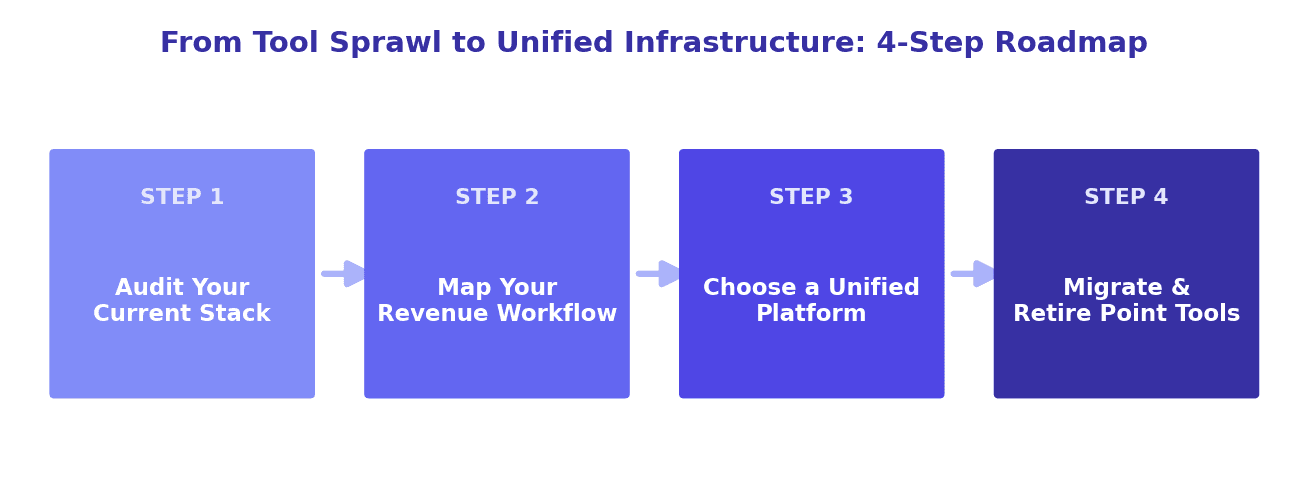
Step 1: Audit Your Current Stack
List every AI tool your team pays for. Note what it does, who uses it, and where its data lives. Most companies discover overlapping tools and subscriptions nobody has opened in months. This audit alone usually funds the migration.
Step 2: Map Your Revenue Workflow End to End
Draw the real journey from first touch to renewal. Mark every hand-off where data must move between tools. Each of those hand-offs is a fracture point where deals slow down or die. These fractures define your integration priorities.
Step 3: Choose a Unified Platform
Select infrastructure that covers your core revenue workflows on a single data layer. Prioritize systems designed for AI agent orchestration, where automations can trigger each other natively. The question is not "what does this tool do?" but "what does this system connect to?"
Step 4: Migrate in Phases and Retire Point Tools
Move one workflow at a time, starting with your most fractured hand-off. As the unified system takes over each workflow, cancel the point tools it replaces. Every retired subscription simplifies your stack and cleans your data.
FAQ
What is the difference between AI point tools and integrated infrastructure?
AI point tools solve one narrow task, like writing emails or scoring leads, and store data separately. Integrated infrastructure connects marketing, sales, and success workflows on a single data layer, so every AI action uses the same customer context and feeds results back into one system.
Why is my AI tech stack failing?
Most AI tech stacks fail because of tool sprawl. Each isolated tool creates its own data silo, so teams spend hours moving data manually, insights conflict, and revenue signals fall through the gaps between disconnected apps.
What is revenue automation infrastructure?
Revenue automation infrastructure is a unified platform where data, AI agents, and workflows operate as one system across the entire revenue journey. Instead of subscribing to disconnected AI plugins, teams build automated pipelines that run from first touch to renewal on shared data.
How do I consolidate my AI tools?
Start by auditing your current stack and mapping your revenue workflow end to end. Then choose a unified platform that covers your core workflows on one data layer, migrate in phases, and retire point tools as the integrated system replaces them.
Conclusion
Your AI tech stack is not failing because AI does not work. It is failing because fifteen disconnected tools can never behave like one connected system. Point tools create fragmented workflows and data silos. Integrated infrastructure creates a compounding advantage.
The companies that win the next era of revenue will not be the ones with the most AI subscriptions. They will be the ones that built unified revenue automation infrastructure, where every signal, every agent, and every team works from the same picture. Stop collecting tools. Start building infrastructure.