
Most marketing teams picked an AI tool the way they picked a project management tool: someone tried one, it worked, everyone standardized on it, and the decision was never revisited. Two years later that single subscription is handling the strategy brief, the ad copy, the competitor research, and the spreadsheet cleanup, and the team quietly assumes the uneven results are just what AI is like.
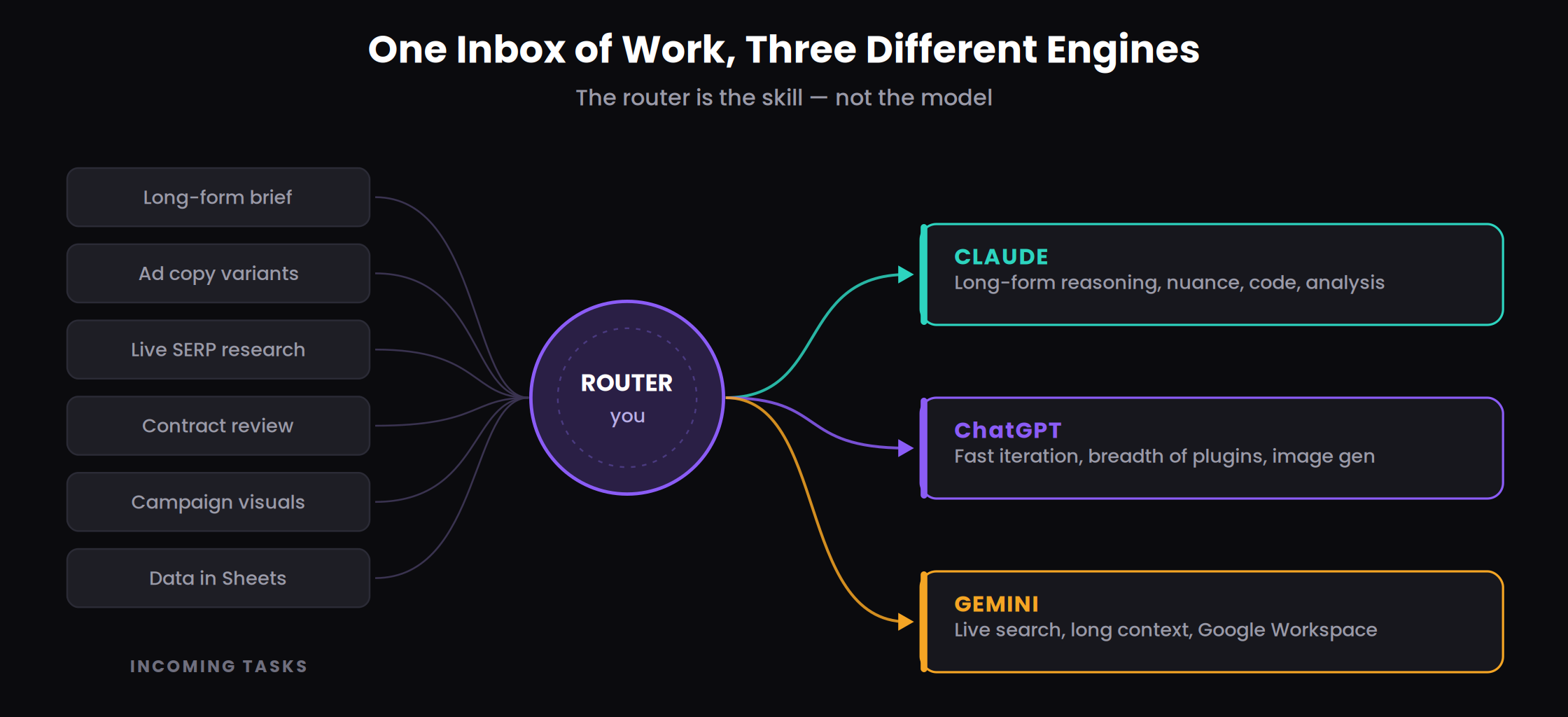
The highest-performing teams stopped doing that. The hidden trend right now is model diversification: instead of one assistant for everything, marketers run a multi-model stack and route each task to whichever platform is architecturally suited to it. It is not tool-hoarding and it is not indecision. It is the recognition that ChatGPT, Claude, and Gemini were built with different priorities, and that the gap between them shows up precisely on the tasks that matter most.
Why One Model for Everything Quietly Costs You
A single-model workflow does not fail loudly. It fails as a slow tax: research that confidently cites something that no longer exists, a strategy document that is fluent but shallow, forty ad variants that all sound like the same variant. Because the output is always plausible, nobody flags it. The team just does a bit more editing than they expected and concludes that AI is roughly a fifty-percent-useful tool.
The underlying cause is architectural, not qualitative. These systems differ in training approach, context handling, retrieval design, and how tightly they integrate with a surrounding product ecosystem. Those choices produce genuinely different behavior on different task types. Using one model everywhere means accepting its weakest dimension on every task that happens to land there.
Worth saying plainly: no model is bad at any of this. All three are broadly capable, and the leaderboard reshuffles with every release. Multi-model AI for marketing is not about ranking vendors. It is about noticing that the differences, however small in the abstract, compound across hundreds of tasks a month.
Reading the Differences Without Picking a Winner
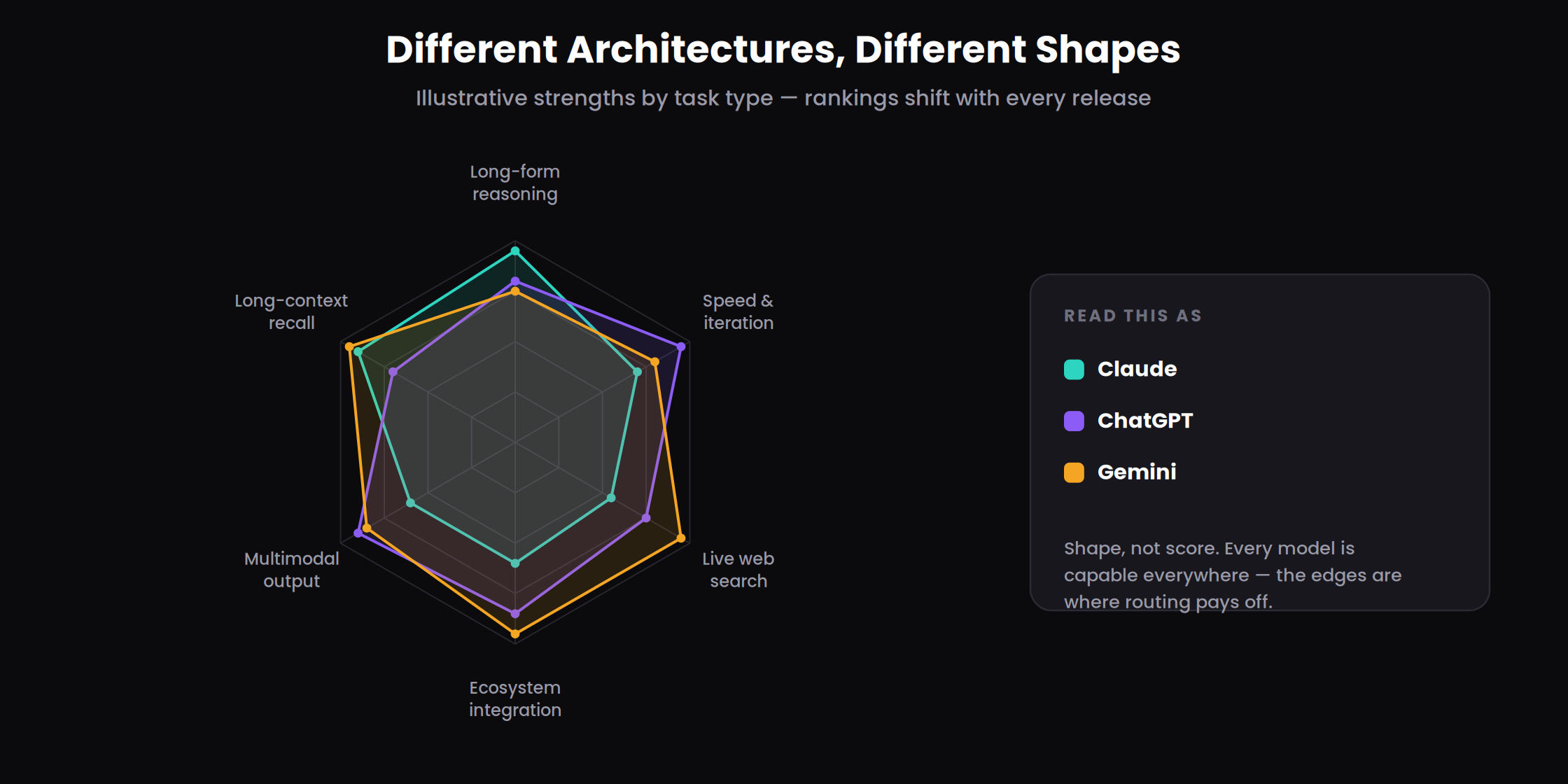
A useful way to think about the three platforms is as shapes rather than scores. Each one bulges in a different direction, and the bulges are where routing earns its keep. Treat the following as directional tendencies you should verify against your own work, not as fixed specifications, because every one of these is a moving target.
Claudetends to be the pick for sustained reasoning over long, nuanced material: a fifty-page brand audit, a messy strategy document, a piece of writing where tone and judgment matter more than speed. It generally holds a long argument together without drifting, which is what you want when the output is going to a client.
ChatGPTis usually the fastest to iterate with, has the widest plugin and tooling ecosystem, and handles multimodal output well. When you need volume and variation quickly, or want image generation and text in the same session, it is often the shortest path.
Geminiis built closest to live search and the Google Workspace stack. For anything that depends on what is true this week, or that needs to land inside Docs, Sheets, or Slides where your team already works, that proximity is a real structural advantage rather than a feature checkbox.
The Routing Framework: Plot the Task Before You Pick the Tool
Routing decisions get easier when you stop asking "which model is best" and start asking "what does this task actually require." Two questions do most of the work: how much depth of reasoning does it need, and does it depend on information the model cannot already have?
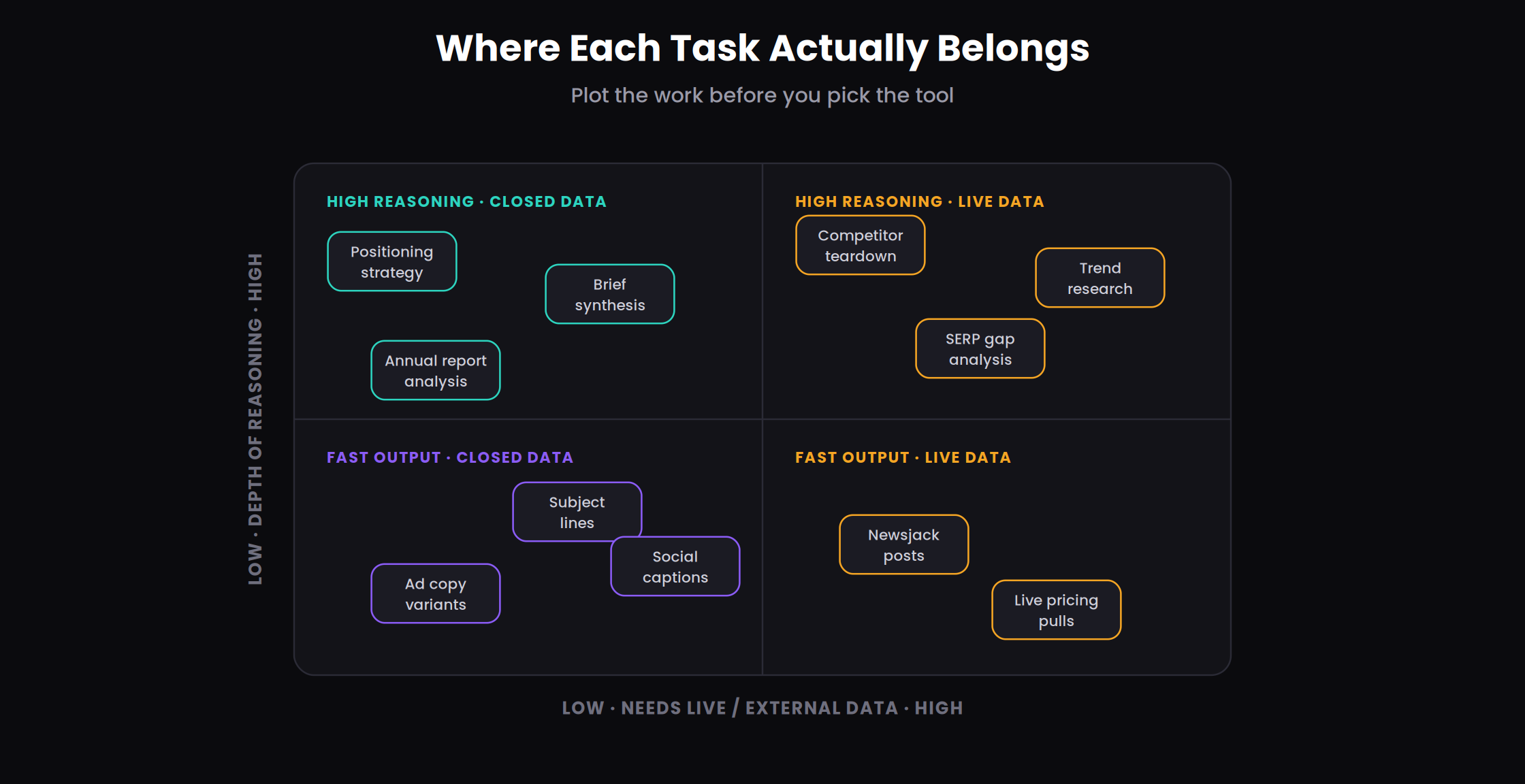
Map the task onto those two axes and the routing usually becomes obvious. Deep reasoning over material you already own goes to your strongest long-context reasoner. Anything gated on live external data goes to whichever model has real search. High-volume, low-stakes generation goes to the fastest iterator. Tasks in the bottom-right, needing both speed and live data, are usually two steps rather than one: pull the facts in one model, generate in another.
What This Looks Like Across a Real Campaign Week
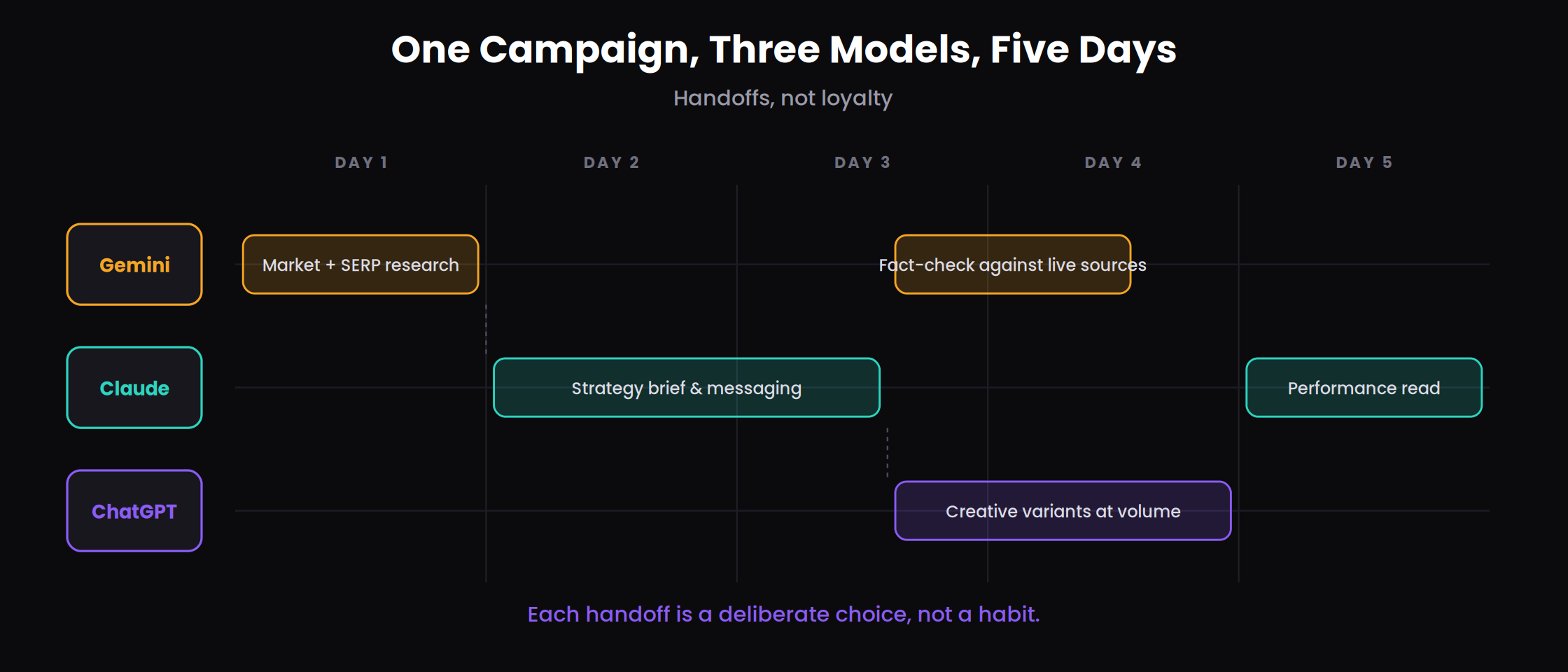
In practice the stack does not mean opening three tabs and asking the same question three times. It means a sequence of deliberate handoffs, where the output of one model becomes the input to the next. Live market and SERP research happens where search is native. The synthesis into positioning and messaging happens where long-form reasoning is strongest. Creative variants get produced at volume where iteration is fastest. Claims get fact-checked back against live sources before anything ships.
The handoff itself is the part teams get wrong. Copy-pasting a wall of raw output into the next model wastes most of the advantage. What travels well between models is a tight, structured artifact: a summarized research brief with sources, a messaging framework with explicit constraints, a creative brief that states what must not change. Treat each model as a specialist colleague receiving a handover, not as a clipboard.
The Costs Nobody Puts in the Business Case
Model diversification is not free, and pretending otherwise is how it gets abandoned three months in. There are three real costs. The first is subscription spend, which for a mid-sized team is meaningful but rarely the binding constraint. The second is cognitive overhead: every additional tool is another interface, another set of quirks, another place where work can get lost. The third and largest is governance, because sensitive campaign data, customer lists, and unreleased positioning are now moving across three vendors with three different data policies.
The honest test is volume. If your team runs a handful of AI-assisted tasks a week, one good model and a clear head will beat a fragmented stack. If you are running hundreds of tasks a month across research, strategy, creative, and analysis, the specialization gains stop being theoretical. Somewhere in between is a threshold worth finding deliberately rather than drifting past.
How Collide Approaches the Multi-Model Stack
This is the operating model behind Collide's approach to AI-assisted campaign work. Model choice is treated as a routing decision made per task, not a procurement decision made once a year. Research that depends on the current state of a market goes where live retrieval is strongest; strategy and long-form synthesis go where sustained reasoning holds up; high-volume creative production goes where iteration is fastest. The handoffs between them are structured artifacts rather than raw dumps, and the routing rules are written down so they survive people changing roles. The result is that the quality of the output stops depending on which tab someone happened to have open.
Your Roadmap to a Multi-Model Stack
Building this does not require a procurement cycle or a new operations hire. Four steps get a team most of the way there.
Step 1: Audit What You Are Actually Asking AI to Do
For two weeks, log every AI-assisted task and tag it by type: research, synthesis, generation, analysis, formatting. Most teams are surprised by the distribution. You cannot route work you have never categorized, and the log usually reveals that one or two task types dominate the volume.
Step 2: Run the Same Real Task Through All Three
Benchmarks are a poor proxy for your workflow. Take one genuinely representative task from your log, ideally one you already know the right answer to, and run it identically through each platform. Judge the outputs blind if you can. This is the only evidence that will actually change how your team works, because it is evidence about your work.
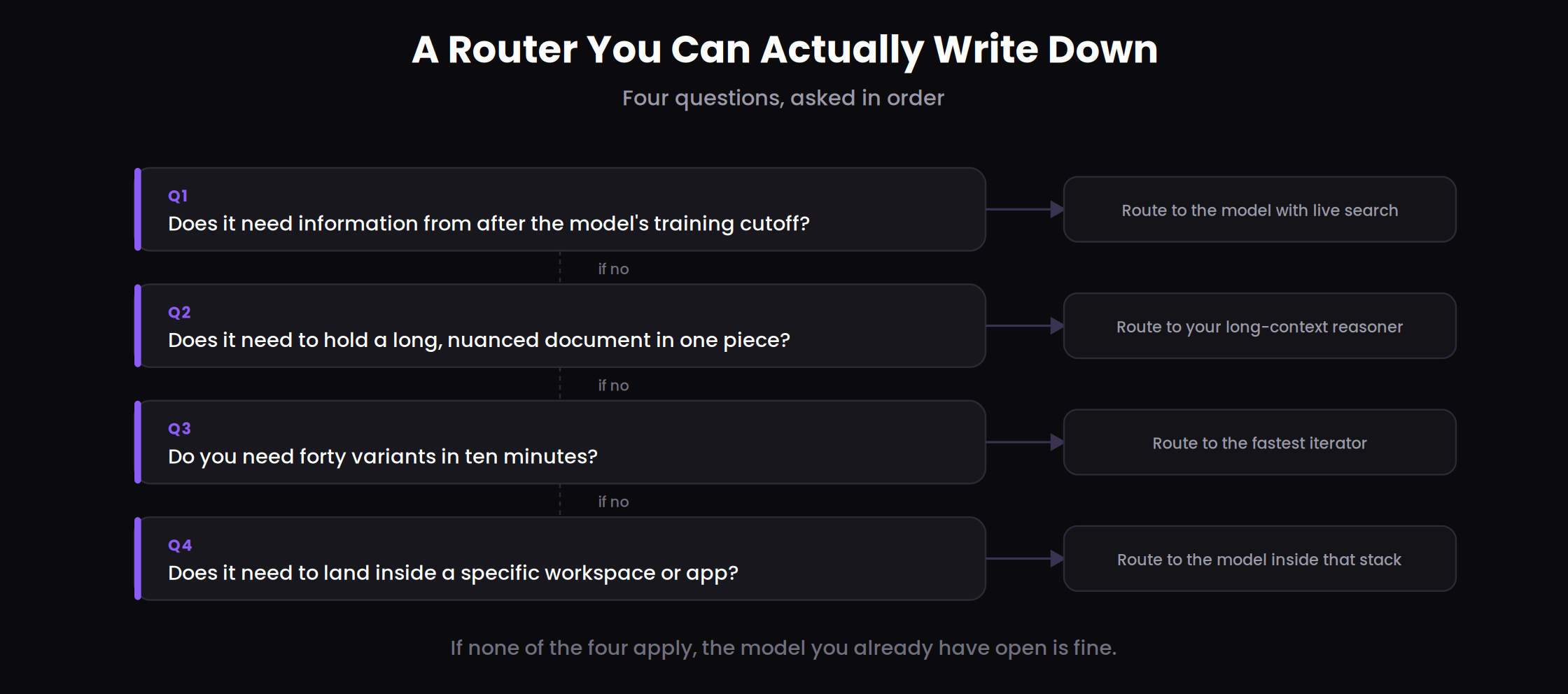
Step 3: Write the Router Down
Turn what you learned into four or five explicit if-then rules and put them where the team works, in the onboarding doc or pinned in the channel. "Anything needing information from the last six months goes to the model with live search." "Client-facing strategy documents go to the long-context reasoner." Undocumented routing lives in one person's head and leaves when they do.
Step 4: Set the Data Rules Before You Scale It
Decide explicitly what is allowed to go into which platform. Unreleased positioning, customer data, and anything under client NDA need a named home and a named exclusion list. Do this while the stack is small, because retrofitting data governance onto an established multi-model habit is considerably harder than establishing it at the start.
Measuring the Impact: Is the Stack Actually Earning Its Keep
Edit distance to shippable: how much rework a first draft needs before it is usable. This should fall as routing improves.
Rework rate on research: how often AI-sourced facts turn out to be wrong or stale. The clearest signal that research is landing in the wrong model.
Task-to-model match rate: what share of tasks followed the written router versus whatever was already open.
Total cost per finished deliverable: subscriptions plus human editing time, per shipped asset, not per seat.
Conclusion
Model loyalty is a habit, not a strategy. The teams pulling ahead are not the ones that found the single best AI; they are the ones that stopped looking for it and built a routing layer instead. That layer is cheap to build, it is mostly a documented set of judgments, and it keeps working even as the underlying models leapfrog each other, which they will continue to do.
The question worth asking is no longer "which AI should we standardize on?" It is "what kind of task is this, and where does that kind of task belong?" Answer that consistently, and the models become interchangeable parts of a system you own rather than a vendor decision you are stuck with.