
Marketing teams face a massive problem right now. The old way of working is too slow. Traditional agencies use silos to manage work. They have a strategy team, a creative team, and a data team. These teams rarely talk to each other in real time. One team finishes a task and passes it to the next. This creates a long chain of delays.
By the time a campaign launches, the market has already changed. Trends move faster than a traditional agency can react. This is why companies are moving toward a new model. They are adopting the AI marketing pod structure to stay ahead.
The Death of the Siloed Agency Model
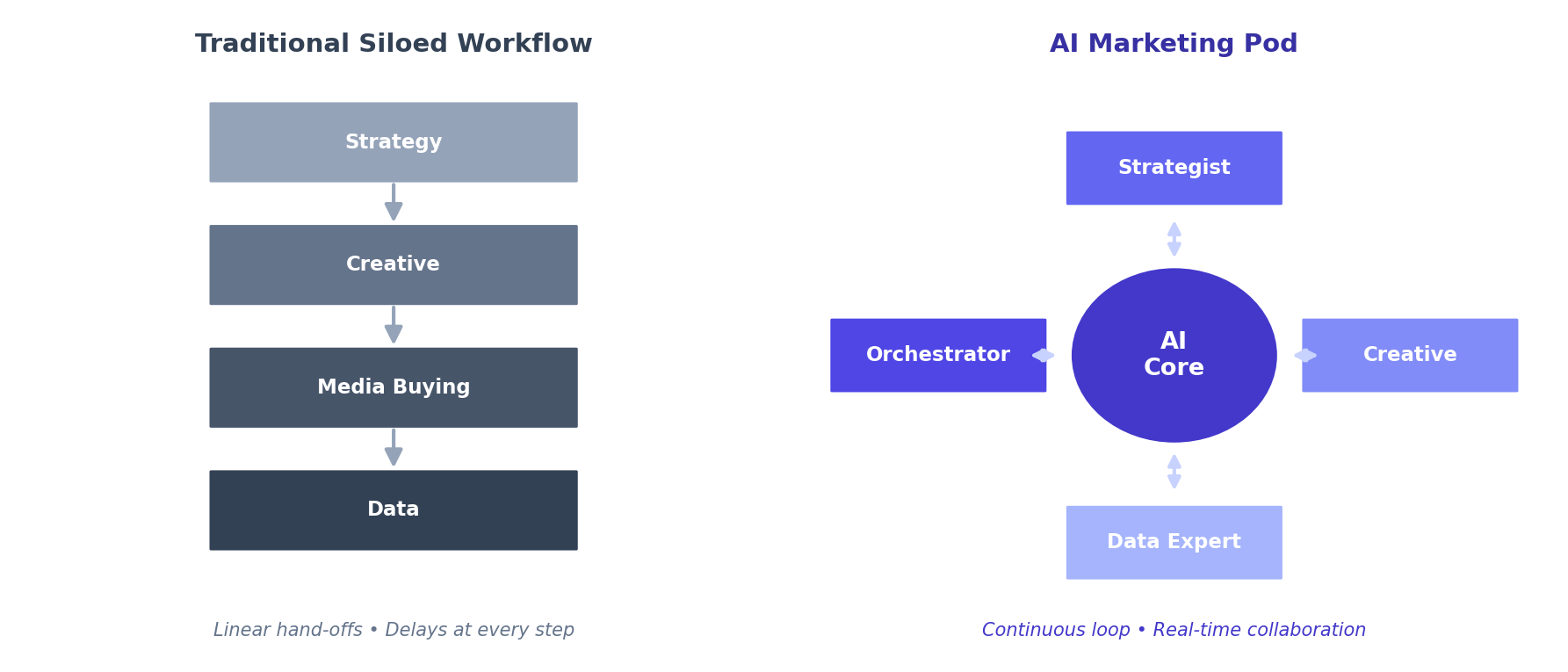
In a traditional model, work moves in a straight line. The strategist writes a brief. They send it to the creative director. The creative team makes the assets. Then, they send those assets to the media buyers. Finally, the data team looks at the results.
This model creates friction at every step. Each hand-off is a chance for a mistake. Communication breaks down when people move between departments. You also lose time. If the creative team needs more info, they must go back to the strategist. This back-and-forth kills your speed.
Consider a retail brand during a sudden viral trend. A fashion trend starts on social media on Monday. The brand's strategy team meets on Tuesday to discuss it. The creative team starts work on Thursday. The ads do not go live until next week. By then, the trend is dead. The brand wasted money on a stale idea.
Defining the AI Marketing Pod Structure
The AI marketing pod structure changes everything. Instead of separate departments, you build small, agile teams. We call these "pods." A pod is a cross-functional AI marketing team. It contains all the skills needed to finish a project from start to finish.
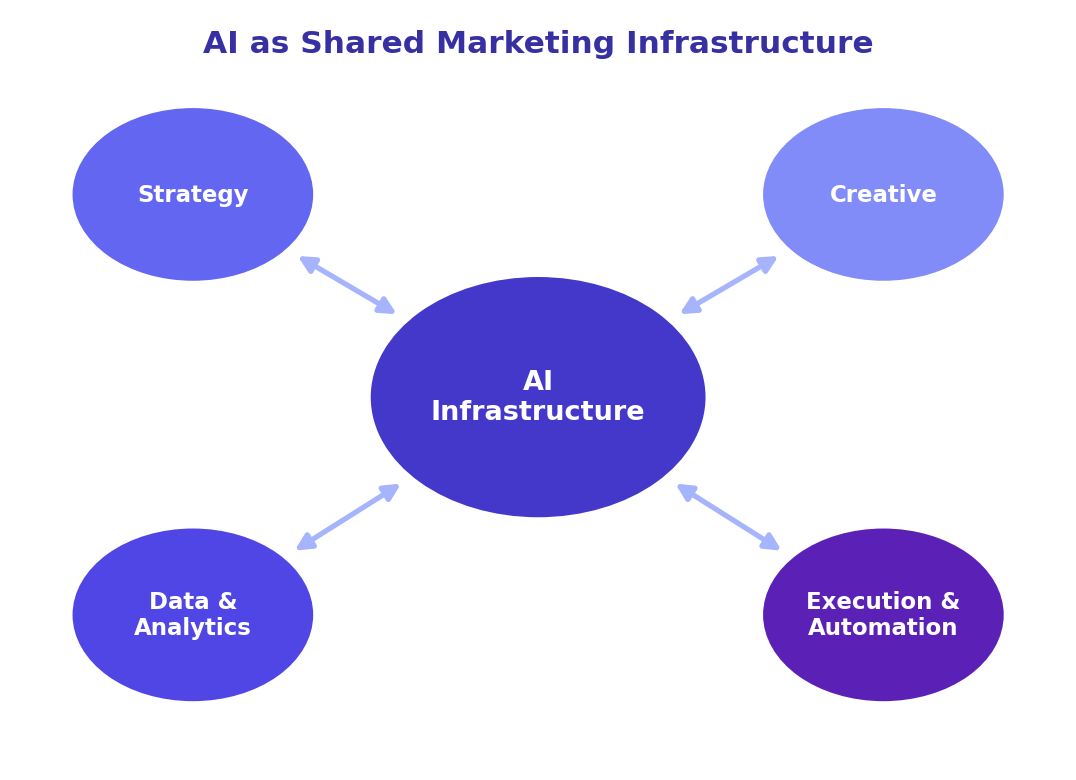
A single pod might include a strategist, a creative specialist, and a data expert. However, they do not work alone. They use AI as their shared infrastructure. This means the AI tools sit at the center of the pod. The team uses these tools to communicate and execute tasks instantly.
This is an agile marketing pod model. It focuses on speed and constant feedback. Instead of waiting for a weekly meeting, the pod works in a continuous loop. They use AI marketing agent orchestration to manage many tasks at once. This allows the pod to act like a much larger agency.
AI as the Shared Infrastructure of the Pod
In a pod, AI is not just a tool for writing emails. It is the foundation of the entire workflow. Think of AI as the digital glue that holds the pod together. It connects the creative side to the data side.
When the data specialist sees a shift in customer behavior, the AI flags it. The AI can then suggest new creative directions to the designer. This happens in minutes, not days. This setup creates massive AI marketing operational efficiency.
Traditional teams use different tools that do not talk to each other. A pod uses an integrated tech stack. This stack allows for marketing workflow automation. For example, an AI agent can pull data from an ad platform and automatically update a creative brief. This removes the need for manual data entry.
Linear Workflows vs. Real-Time Campaign Orchestration
We must look at how work actually happens. Traditional marketing uses linear workflows. It is a series of steps: Step A, then Step B, then Step C. If Step B fails, the whole process stops.
The AI marketing pod structure uses real-time campaign orchestration. This is a web of activity rather than a straight line. The pod monitors live data. They use AI agents to make small, instant changes to active campaigns.
Let's look at an e-commerce example. A brand is running ads for a new sneaker. The AI agent notices that people in New York are clicking more than people in Los Angeles. The agent instantly shifts more budget to the New York audience. It also tells the creative specialist to generate a "New York Style" version of the ad. The pod reviews the work, and the new ad is live within an hour. This is AI-first marketing execution in action.
Key Roles in an AI-First Marketing Pod
Shifting to pods changes the people involved. You do not need fewer people, but you need different skills. The roles within a pod are more fluid. Everyone must understand how to work with AI.
The Emergence of the AI Experience Architect
One of the most important new roles is the AI Experience Architect. This person does not just manage people. They manage the relationship between humans and AI agents. They design how the AI tools interact with the team.
The AI Experience Architect ensures the pod stays on track. They build the AI marketing governance framework. This framework makes sure the AI follows brand guidelines. They also ensure the "human-in-the-loop" process works. This means a human always checks the AI's work to maintain the brand voice. Without this role, a pod might produce content that is fast but feels robotic or off-brand.
Other Essential AI Marketing Team Roles
Other roles also evolve. A "Data Specialist" becomes an "AI Data Orchestrator." They focus on feeding high-quality data into the AI models. A "Creative Lead" becomes a "Prompt Engineer and Creative Director." They guide the AI to produce visual assets that match the brand's soul.
These roles work together to scale marketing with AI agents. Instead of one person making one video, the pod uses AI to create fifty variations of that video. The humans focus on the high-level vision and the final quality check.
A Framework for Building Your First AI Marketing Pod
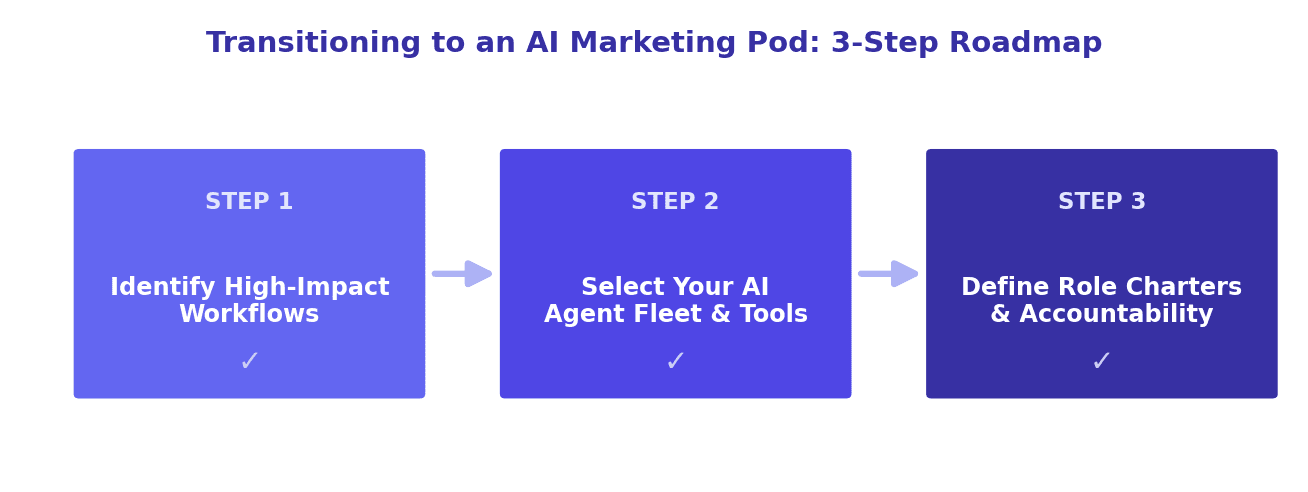
Transitioning to AI marketing pods can feel scary. You do not have to change your whole company overnight. You can start with one small pod for a specific project. Follow these three steps to get started.
Step 1: Identifying High-Impact Automation Workflows
Do not try to automate everything at once. Look for the biggest bottlenecks in your current process. Where do things get stuck? Is it the creative approval process? Is it the data reporting?
Start with these high-impact areas. If your team spends ten hours a week writing social media captions, start there. Use marketing workflow automation to handle those tasks first. This gives your team time to learn how to work in a pod structure.
Step 2: Selecting Your AI Agent Fleet and Tools
Once you know what to automate, you need the right tools. You need an AI marketing infrastructure that supports collaboration. You need tools for text generation, image creation, and data analysis.
More importantly, you need tools that can talk to each other. Look for platforms that allow for AI marketing agent orchestration. You want your data tool to trigger your creative tool. This creates the "real-time" feeling that makes pods so powerful.
Step 3: Defining Role Charters and Accountability
In a pod, roles are different. You cannot use old job descriptions. You must create "role charters." A charter explains what a person is responsible for in the pod.
It also explains their relationship with the AI. For example, a charter might say: "The Creative Specialist is responsible for the final visual output.
The AI Agent is responsible for generating initial drafts." This prevents confusion. It also ensures that humans remain the final decision-makers.
Measuring Success: KPIs for the Pod Model
You cannot measure a pod using old metrics. If you only look at "cost per lead," you miss the bigger picture. You need new KPIs to see if your pod is actually working.
First, measure Speed to Market. How long does it take to go from an idea to a live ad? A successful pod should reduce this time by 50% or more.
Second, measure Output Volume per Human. How many campaign variations can one person manage? In a pod, this number should grow significantly.
Third, measure Agent Utilization. Are your AI agents actually doing the heavy lifting? If your team is still doing all the manual work, you have not built a true pod.
Finally, track Brand Consistency Scores. Use human reviews to ensure the AI is not drifting away from your brand voice. This ensures that speed does not come at the cost of quality.
Consider a SaaS company that moved to a pod model. Before the move, they launched two campaigns per month. After building an AI pod, they launched twenty campaigns per month. They did not hire twenty more people. They simply gave their existing team the power of an AI agent fleet.
FAQ
What is an AI marketing pod structure?
An AI marketing pod structure is a cross-functional AI marketing team designed for speed. Instead of traditional silos, pods use an agile marketing pod model where humans and AI agents work together in a continuous loop to execute campaigns.
How do AI marketing pods improve efficiency?
They increase AI marketing operational efficiency by using marketing workflow automation. By integrating AI as shared infrastructure, teams can move from linear workflows to real-time campaign orchestration, reducing delays and manual errors significantly.
What are the key AI marketing team roles?
New roles include the AI Experience Architect, who manages human-AI interaction, and AI Data Orchestrators. These roles focus on scaling marketing with AI agents while maintaining brand voice through human-in-the-loop processes.
How do I start transitioning to AI marketing pods?
Start by identifying high-impact automation workflows. Then, select your AI agent fleet and define clear role charters. This structured approach helps your team adapt to AI-first marketing execution without overwhelming your existing staff.
Conclusion
The shift to an AI marketing pod structure is not optional. The market is moving too fast for silos. If you want to stay relevant, you must embrace agile, cross-functional teams.
By combining human creativity with AI orchestration, you create a powerhouse. You reduce friction, increase speed, and scale your impact. Start small, build your infrastructure, and prepare to lead the next era of marketing.