
For the last century, marketing has been built on a single assumption: a human being sees the message. Every discipline downstream of that assumption — brand storytelling, emotional positioning, packaging design, the carefully chosen hero image — exists because a person was going to look at it and feel something. That assumption is quietly breaking.
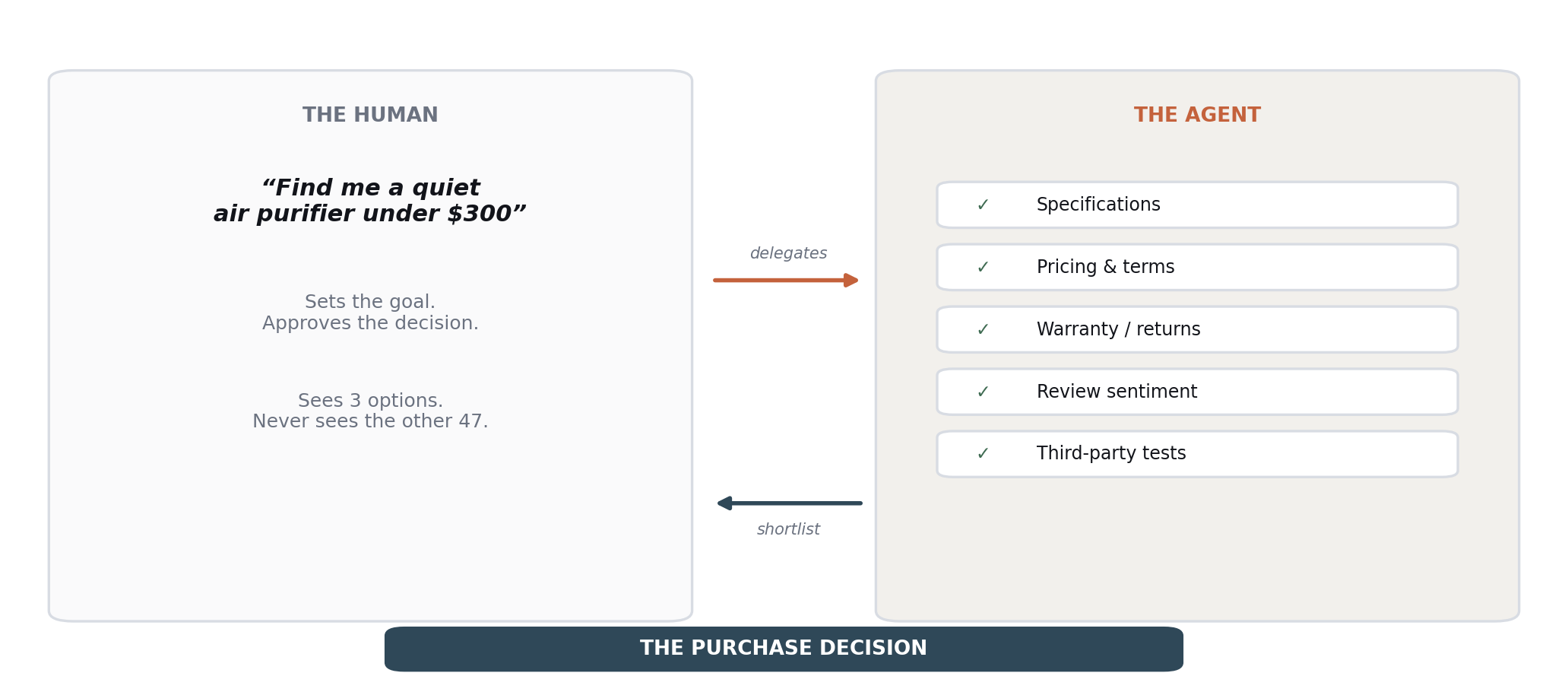
Consumers are increasingly delegating the middle of the purchase journey to AI assistants. They no longer open twelve tabs to compare mattresses or spend an afternoon pulling vendor pricing into a spreadsheet. They ask an agent to do it, and the agent returns with three options and a recommendation. The human still decides. But the human decides from a shortlist that a machine assembled, using criteria the machine could actually evaluate. If your product does not survive that filter, the shopper never sees it.
This is the shift to machine customers, and it changes what good marketing looks like. Persuasion aimed at a machine is not the same craft as persuasion aimed at a person.
Why the Funnel Now Has a Non-Human Middle
The traditional funnel assumed a continuous human presence from awareness to purchase. AI agent commerce breaks that continuity. Awareness and final approval stay human. Consideration and evaluation — the part where most marketing budget actually gets spent — increasingly do not.
An agent evaluating a purchase does not respond to what marketing has historically optimized for. It does not register a lifestyle photograph. It is not moved by a tagline. It does not experience brand affinity as a feeling. What it does is retrieve, parse, compare, and rank. It reads specifications, return policies, warranty terms, structured pricing, review sentiment, availability, and compatibility with things the user already owns. Then it produces a defensible recommendation it can explain back to its human.
The practical consequence is uncomfortable for a lot of brands: a product with weaker emotional positioning but cleaner, more complete, more machine-legible information will beat a beloved brand with a beautiful site and a vague spec sheet. Marketing to AI agents rewards clarity and completeness over atmosphere.
Four Shifts Required to Sell to Machine Customers
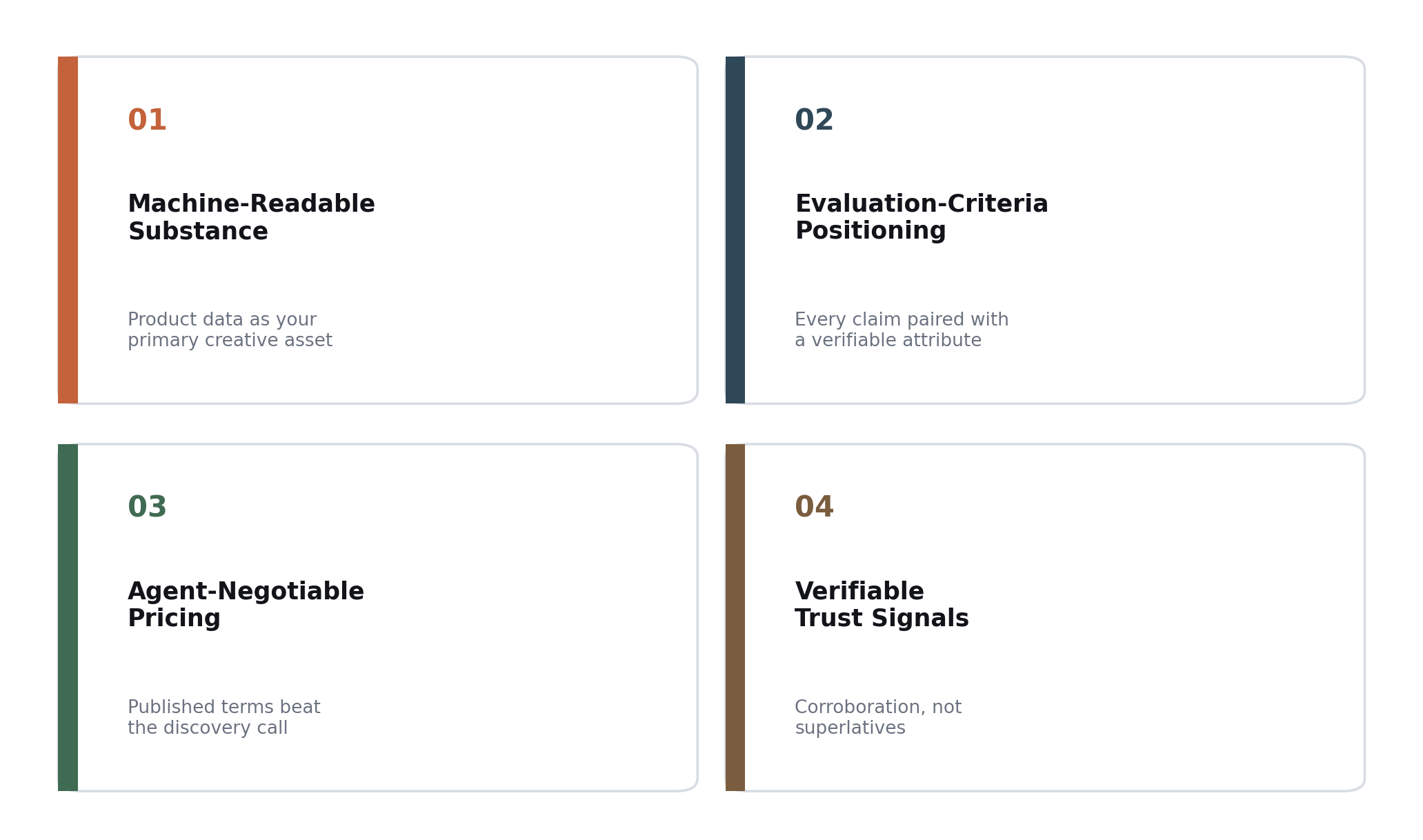
Shift 1: Treat Your Product Data as Primary Creative
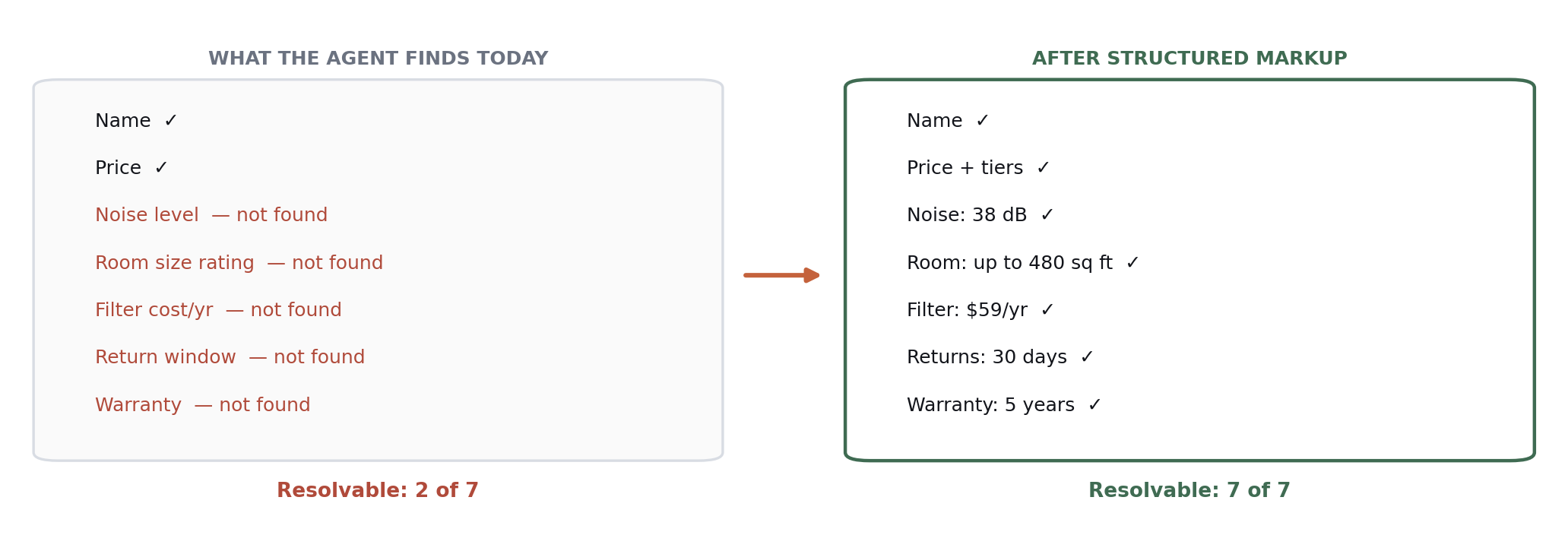
For most organizations, structured product data is an afterthought owned by an operations team and never reviewed by marketing. In an agent-mediated market, it is the highest-leverage creative asset you have. Attribute completeness, consistent units, explicit compatibility statements, clear sizing, unambiguous return windows, machine-readable specifications — these are what actually get evaluated.
The test is simple and slightly brutal. Ask an AI assistant to compare your product against two competitors using only what is publicly available. Whatever it cannot find, it will treat as absent, and absent almost always loses to specified. Most brands running this test for the first time discover their agent-facing presence is far thinner than their human-facing one.
Shift 2: Position Against Evaluation Criteria, Not Aspirations
Human positioning works in adjectives: premium, effortless, trusted, thoughtfully designed. Agent positioning works in resolvable claims. An agent cannot verify "effortless." It can verify a fifteen-minute setup time, a two-year warranty, a 40-decibel noise rating, and a thirty-day no-questions return policy.
This does not mean abandoning brand. It means every aspirational claim needs a concrete, checkable counterpart sitting underneath it. "Built to last" is atmosphere; "ten-year warranty, replacement parts stocked through 2036" is the same promise in a form a machine can score. The brands that win agentic search will be the ones that translate their entire value proposition into verifiable attributes without losing the human-facing story on top.
Shift 3: Make Your Pricing and Terms Negotiable by Machine
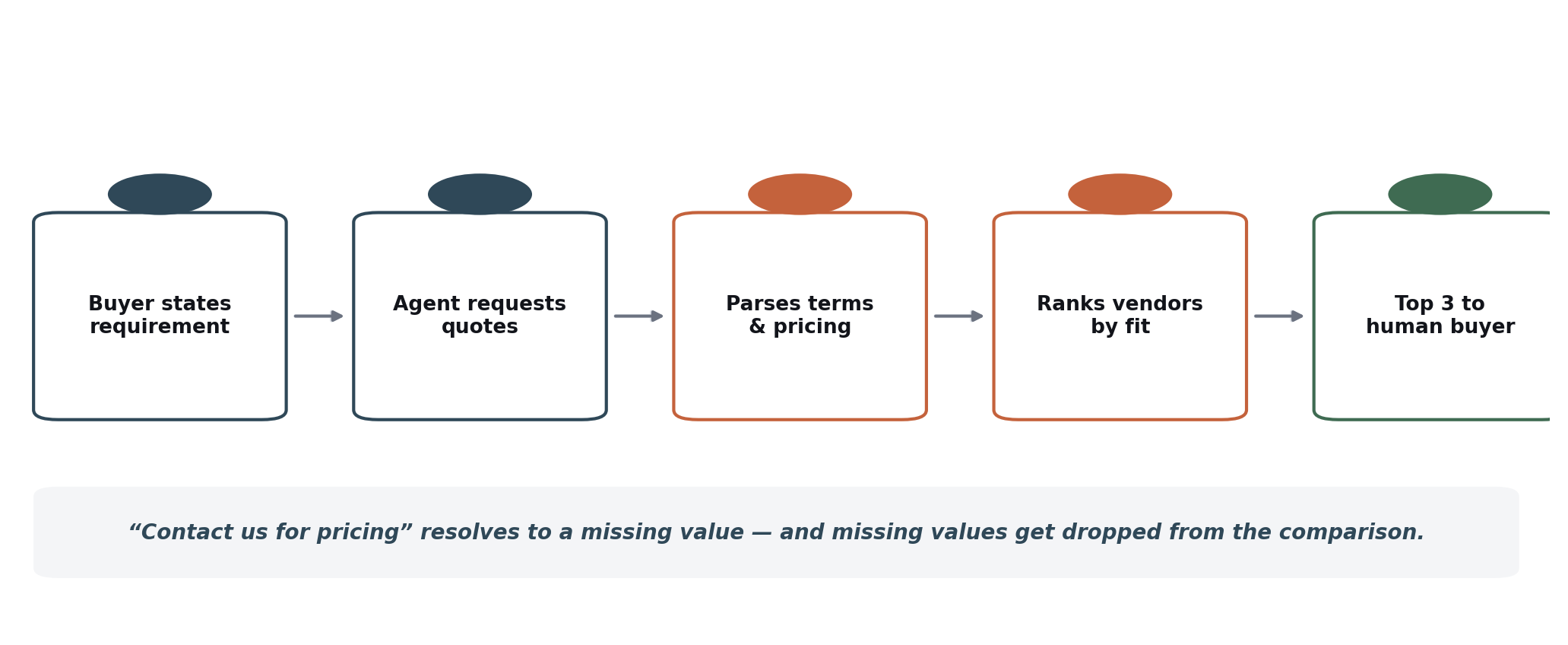
Agents are beginning to do more than compare — they transact, apply discounts, check price history, and in B2B contexts, request quotes and negotiate terms. A pricing model that requires a sales call to reveal is invisible to an agent-driven evaluation. "Contact us for pricing" reads to a machine as a missing value, and missing values get down-ranked or dropped.
For B2B specifically, this is the sharpest break with current practice. Gated pricing has been a deliberate lead-generation strategy for decades. In an agentic buying process, gating your pricing does not create a lead — it removes you from the comparison set before a human ever learns you exist. Published ranges, transparent tiering, and clear volume logic increasingly outperform the discovery call.
Shift 4: Build Trust Signals a Machine Can Actually Verify
Human trust is built through familiarity, design quality, and social proof absorbed over time. Machine trust is built through corroboration. An agent triangulates: does the manufacturer's claim match third-party test results, regulatory filings, certification databases, and the distribution of independent reviews?
This makes third-party verification disproportionately valuable and makes unsupported superlatives actively harmful. A claim an agent cannot corroborate is not neutral — it introduces uncertainty into the ranking, and uncertainty costs you position. Certifications, published test data, standardized review schema, and consistent claims across every surface you control are the new trust stack.
From Persuading People to Qualifying for Consideration
The strategic reframe is this. Marketing's job used to be to make a person want the product. In an agent-mediated market, marketing's job splits in two: qualify for the shortlist a machine builds, then win the human who reviews it.
Those are different jobs with different success criteria. Qualification is an information problem — completeness, structure, verifiability, availability. Winning the human is still a persuasion problem — story, design, trust, differentiation. Teams that collapse these into one strategy will optimize for the wrong reader. Teams that run both will find the machine layer is where their competitors are currently weakest, and therefore where the advantage is cheapest to buy.
It is also worth saying plainly: this does not make brand obsolete. When an agent returns three well-matched options with similar specifications, the human chooses the one they recognize and feel good about. Brand becomes the tiebreaker rather than the filter — which is a demotion in the funnel, but not an elimination.
How Collide Approaches Machine-Customer Readiness
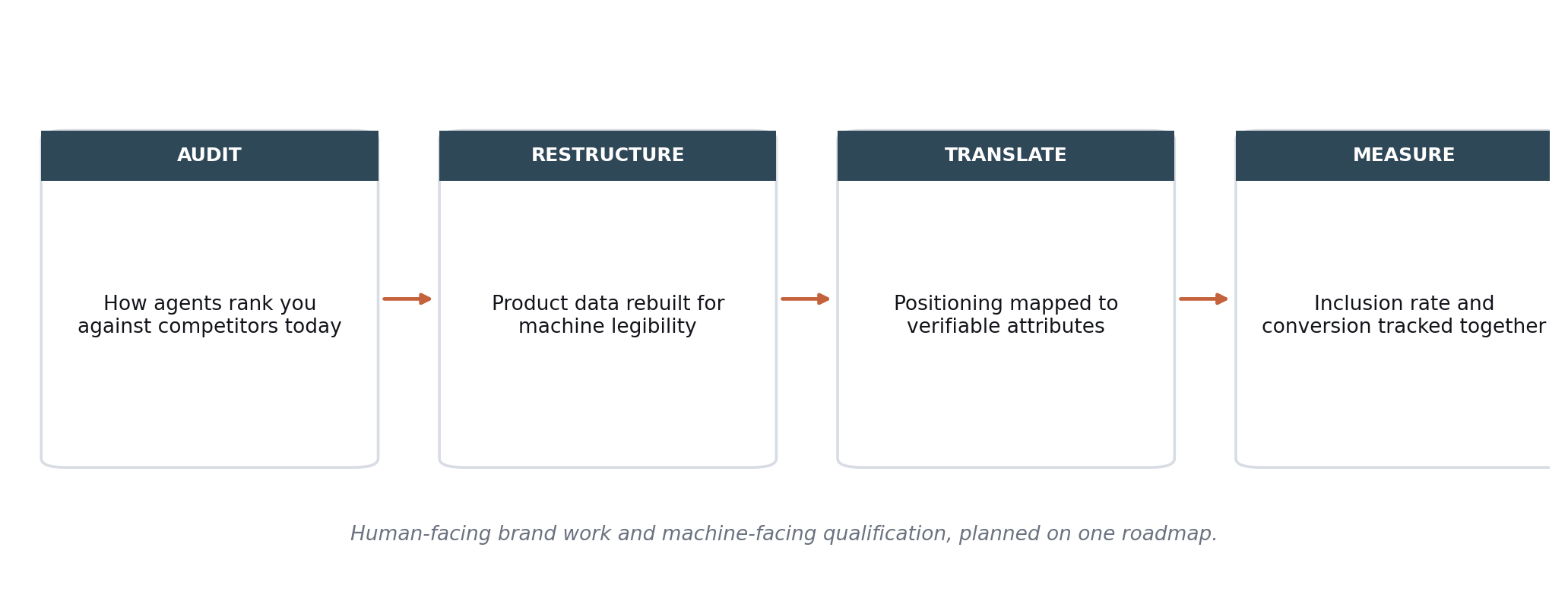
Collide treats agent readiness as a marketing discipline rather than a technical cleanup task. That means auditing how AI assistants currently describe and rank a client's products against competitors, rebuilding structured data and product content so evaluation criteria are explicit and complete, and rewriting positioning so every aspirational claim has a verifiable attribute beneath it. Human-facing brand work and machine-facing qualification work get planned together, on the same roadmap, measured against the same commercial outcome — because in an agentic market they are two halves of one purchase decision.
Your Roadmap to Machine-Customer Readiness
You do not need an agentic commerce strategy team to start. Four steps move most organizations from invisible to competitive.
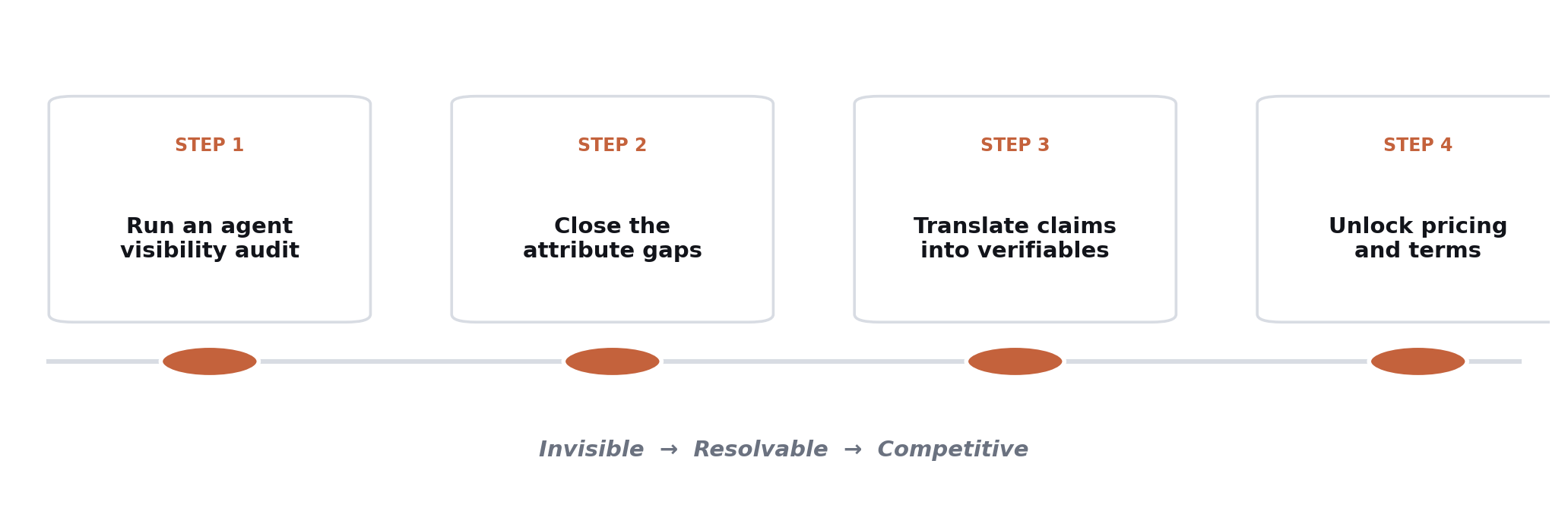
Step 1: Run an Agent Visibility Audit
Ask several AI assistants to recommend a product in your category, then to compare you directly against your two closest competitors. Record what they get wrong, what they cannot find, and whether you appear at all. This is your baseline, and it is usually worse than expected.
Step 2: Close the Attribute Gaps
Every field an agent could not resolve in Step 1 is a task. Fill in missing specifications, standardize units, publish return and warranty terms in plain structured form, and mark up product data properly. This is unglamorous work with the highest immediate return.
Step 3: Translate Positioning Into Verifiable Claims
Take your core brand promises and write the checkable version of each one. Keep the aspirational language for humans; publish the concrete counterpart for machines. If a promise has no verifiable form, that is a signal worth examining on its own.
Step 4: Unlock Pricing and Terms
Publish ranges, tiers, or at minimum a transparent pricing logic. If full transparency is not commercially viable, give agents enough structure to place you correctly in a comparison rather than dropping you from it entirely.
Measuring the Impact: A New Scoreboard for Agentic Marketing
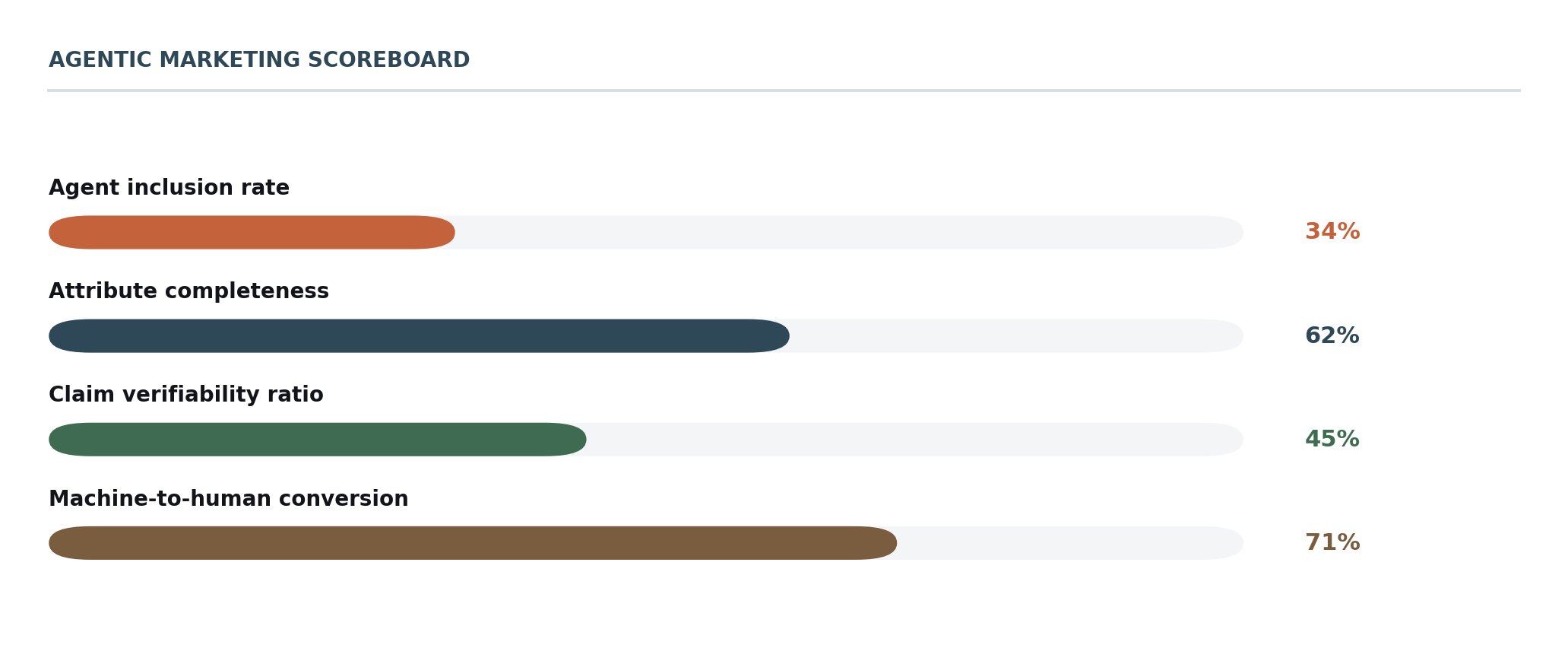
Agent inclusion rate: how often AI assistants include your product in a recommended shortlist for your core category queries.
Attribute completeness score: the percentage of evaluation-relevant fields an agent can resolve about your product without contacting you.
Claim verifiability ratio: how many of your marketing claims have a corroborating third-party or published source behind them.
Machine-to-human conversion: of the shortlists you appear on, how often the human buyer selects you — your true brand tiebreaker strength.
Conclusion
Machine customers are not a future scenario to plan for in three years. They are already assembling the shortlists your buyers choose from, and they are doing it with whatever information you have made available — not with the story you would have told in person.
The brands that adapt first will not be the ones with the best campaigns. They will be the ones whose products are the easiest for a machine to understand, evaluate, and defend to the human who asked. The old question was what will make someone want this. The new question sits in front of it: what would an agent need to know to put us on the list at all? Answer that, and you get to compete for the human again.