
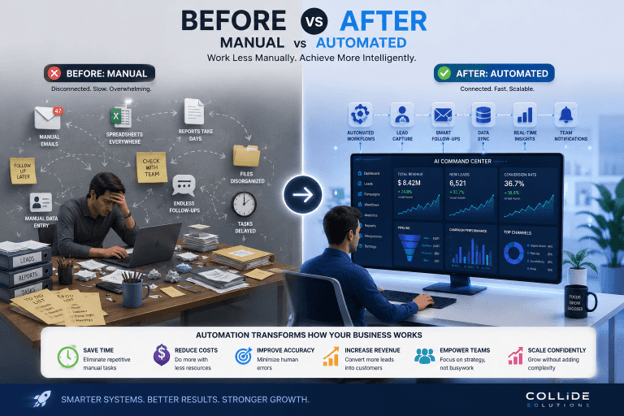
Two businesses sell the exact same product. Same price, same city, same target customer. One founder spends 40 hours a week manually chasing leads, updating spreadsheets, and posting on Instagram whenever they find a free hour. The other has a system that does all of it while they sleep.
Guess which one is still doing 40-hour weeks a year from now, and guess which one has scaled past it.
This is not a story about who works harder. It is a story about manual versus automated, and why the gap between the two is the single biggest predictor of which Indian businesses grow in 2026 and which ones stay stuck.
Before: What Manual Marketing Actually Looks Like
Manual marketing feels productive. Founders are busy every single day. But being busy is not the same as being effective.
Here is what the "before" picture usually looks like inside a growing Indian business:
- A new lead message comes in on Instagram or WhatsApp. Someone notices it hours later, if at all.
- The founder or a junior team member copies the lead's details into an Excel sheet, if they remember to.
- Follow-up happens whenever someone has time, which is often two or three days later, if it happens at all.
- Content gets posted whenever inspiration strikes, with no calendar, no consistency, and no data behind what is working.
- Reporting means opening five different logins at the end of the month and manually piecing together what happened.
- Every new hire has to be trained from scratch on tribal knowledge that lives in someone's head, not in a system.
None of this is anyone's fault. It is simply what happens when growth outpaces infrastructure.
After: What an Automated System Looks Like
Now picture the same business six months into a proper automation build.
- A lead fills a form or messages on WhatsApp. Within seconds, an AI agent responds, qualifies the lead, and logs it directly into a CRM.
- Follow-up sequences trigger automatically based on what the lead does next, not based on who remembered to check a spreadsheet.
- Content publishes on a fixed schedule, informed by what has actually converted in the past, not by whoever was free that afternoon.
- A single dashboard shows leads, conversion rates, and revenue in real time, with no manual pulling required.
- New team members plug into a documented system instead of chasing down answers from three different people.
The work does not disappear. It moves from people to infrastructure, which is exactly the point.
Manual vs Automated: Six Workflows, Side by Side
| Workflow | Manual (Before) | Automated (After) |
|---|---|---|
| Lead follow-up | Hours or days later, if remembered | Seconds, triggered automatically |
| Data storage | Scattered across Excel, WhatsApp, and notebooks | One structured CRM, single source of truth |
| Content publishing | Random, whenever there is time | Scheduled pipeline, data-informed |
| Reporting | Manual pull from five logins monthly | Live dashboard, always current |
| Lead qualification | Founder or staff judgement, inconsistent | AI agent applies the same criteria every time |
| Scaling to more leads | Requires hiring more people | Requires adjusting the system, not headcount |
The pattern is consistent. Manual work depends on a person remembering, noticing, and acting in real time. Automated systems remove that dependency entirely.
Why So Many Founders Stay Manual for Too Long
If automation is this much better, why does almost every growing Indian business start manual and stay that way far longer than it should?
A few honest reasons:
- It feels cheaper in the short term. Paying nothing but time feels free, even though time is the most expensive resource a founder has.
- It feels safer. A spreadsheet you built yourself feels more controllable than a system someone else configured, even when it is quietly costing you leads.
- Nobody calculates the real cost. Founders rarely add up the hours spent connecting tools, fixing broken follow-ups, and re-entering data that a system could have handled instantly.
- The switch feels like a project, not a priority. Building a proper system feels like it can wait until things calm down. Things rarely calm down on their own.
The Hidden Cost of Staying Manual
This is the part most founders underestimate. Manual is not free. It just hides its cost.
A lead that does not get a response within five minutes is dramatically less likely to convert than one that does. A follow-up sequence that depends on a person remembering will always have gaps, and every gap is a lost customer. A founder spending ten hours a week on tasks a system could handle is a founder not spending those ten hours on the parts of the business only they can do.
Multiply this across every lead, every week, every month, and the manual approach is not the cheap option. It is the most expensive one, just spread out so it is harder to see.
Moving From Manual to Automated: A Practical Path
You do not need to automate everything at once, and you should not try to. Here is the order that actually works:
Step 1: Map What You Are Doing Manually Right Now
Every repetitive task, from lead follow-up to reporting, should be written down honestly.
Step 2: Get Your Data Into One Place
Move from scattered spreadsheets into a structured CRM. This is the foundation everything else depends on.
Step 3: Automate the Highest-Impact Workflow First
For most businesses, this is lead follow-up, because it directly affects revenue.
Step 4: Layer In Content and Reporting Automation Next
Once the core loop works reliably, extend the same thinking to publishing and dashboards.
Step 5: Review and Refine Monthly
An automated system is not "set and forget." It needs the same attention a good employee would get, just far less of it.
The Bottom Line
The businesses pulling ahead in 2026 are not working harder than everyone else. They have simply removed the parts of their marketing that depended on a person remembering to act.
If your business is still running on spreadsheets, scattered follow-ups, and manual reporting, the gap between where you are and where an automated competitor already is will only get wider.
Collide Solutions builds the AI marketing systems, lead generation infrastructure, and automation that take Indian businesses from manual to automated, one working layer at a time.
Book Your Free AI Audit to find the highest-impact automation opportunities inside your current marketing workflow.
About the Author
Sneha Patel writes about AI automation, marketing systems, and practical growth infrastructure for Indian businesses at Collide Solutions. Connect with Sneha on LinkedIn.