
Many companies buy AI tools and expect instant magic. They give ChatGPT accounts to employees or buy isolated software for specific teams. However, these quick fixes do not change how the business actually runs.
True success requires a deeper shift. You must move from using standalone tools to building a systemic transformation. This guide shows you how to restructure your business around intelligence.
What is an AI Operating Model?
An AI Operating Model is a blueprint for how your business runs. It connects your people, processes, data, and technology to AI. Instead of treating AI as an add-on, this model puts machine intelligence at the center of your strategy. It acts as an enterprise AI operating model that guides how you make decisions and deliver value.
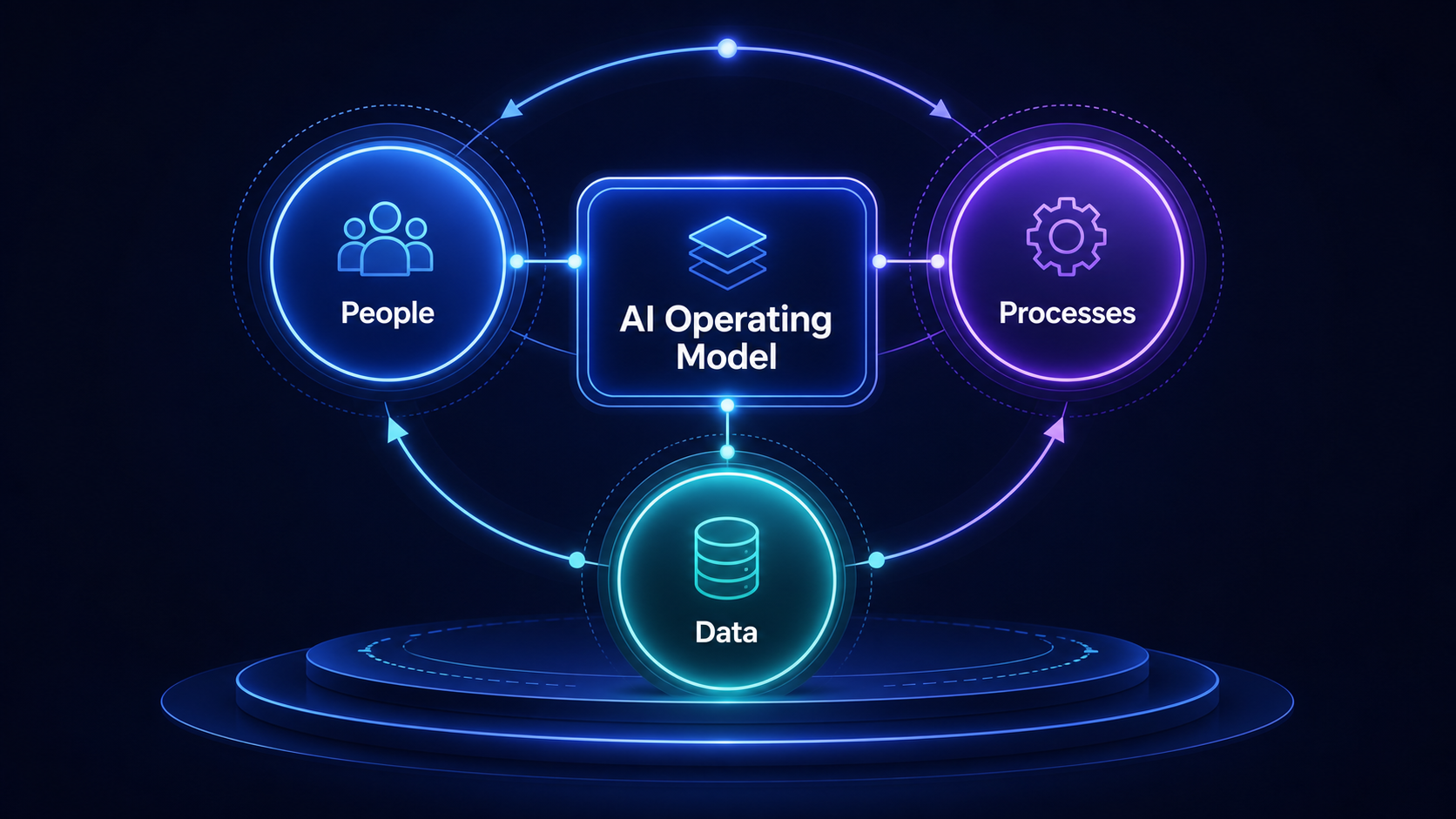
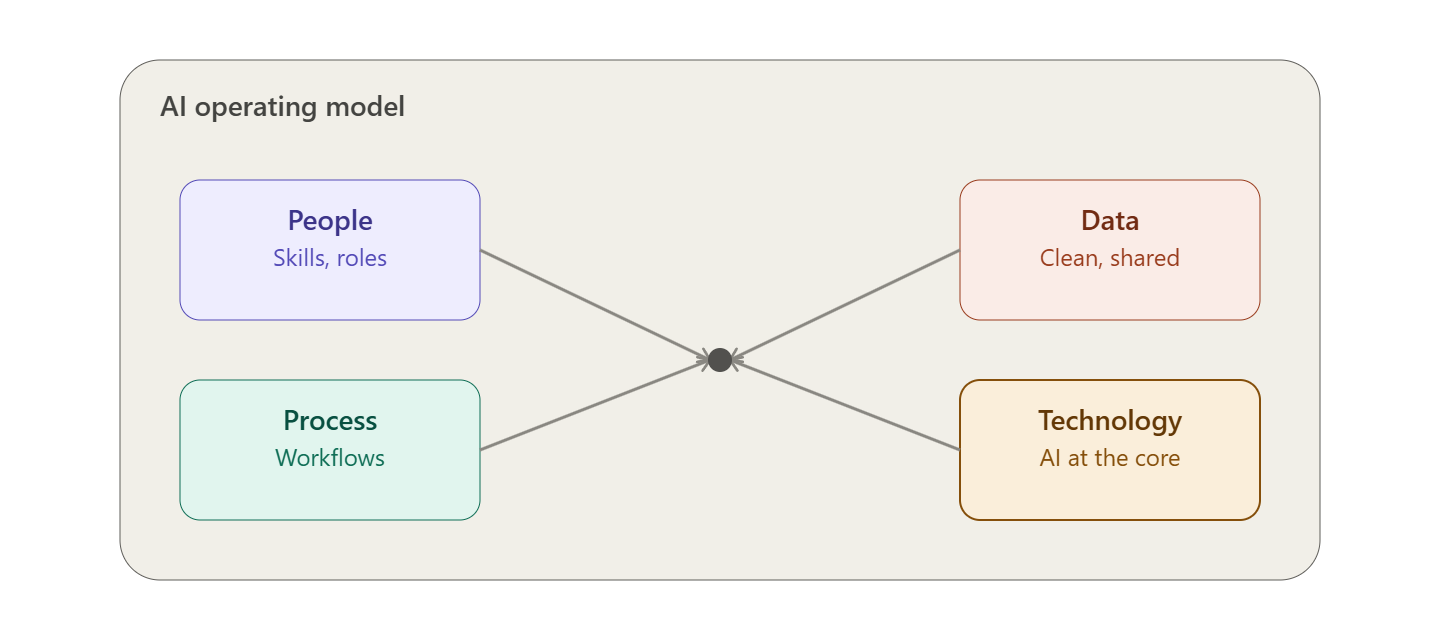
To build this, you need a clear AI operating model framework. This framework helps you organize your teams and scale technology. It ensures that every department uses the same standards and data sources. This structure is the secret to scaling enterprise AI across your entire organization.
AI Tools vs. Integrated Frameworks
Let us compare these two approaches. A standalone tool solves one small problem for one person. An operating model changes how your whole team works together.
Let us look at a practical example. A mid-market retail brand gave their marketing team an AI copy tool. The team wrote ads faster, but sales did not grow.
Later, they built an AI-first workflow. The system analyzed inventory data, predicted demand, and automatically created targeted ad campaigns. Sales grew by 20% because the data connected directly to action.
Why Standalone AI Tools Fail to Scale: The Pilot Limbo
Many leaders get stuck in pilot limbo. They launch dozens of small AI pilots, but none of them reach full production. This happens because isolated tools create data silos. Employees use different tools that do not talk to each other. This setup creates security risks and high subscription costs.
To fix this, you need AI pilot limbo solutions that focus on integration. You must stop launching random experiments. Instead, build a unified platform that supports your entire AI transformation strategy. This shift helps you move from proof-of-concept to real business value.
Core Elements of a Sustainable System
A great model rests on four pillars. First, you need clean, accessible data. Second, you need clear rules for how teams build and use AI. Third, you must train your people to work alongside intelligent systems. Finally, you need the right technology stack to connect everything.
You do not need an enterprise-scale budget to start. Mid-market companies can build these models by focusing on one key department first. Start with customer service or finance. Build a repeatable process there, and then expand to other teams.
Redesigning Workflows and Roles for Human-Agent Collaboration
Automation is no longer just about replacing manual tasks. It is about redesigning roles entirely. You must build human-agent collaboration workflows where humans and AI agents work as partners. In this setup, AI agents handle data gathering, initial analysis, and draft creation. Human employees act as editors, decision-makers, and strategic planners.

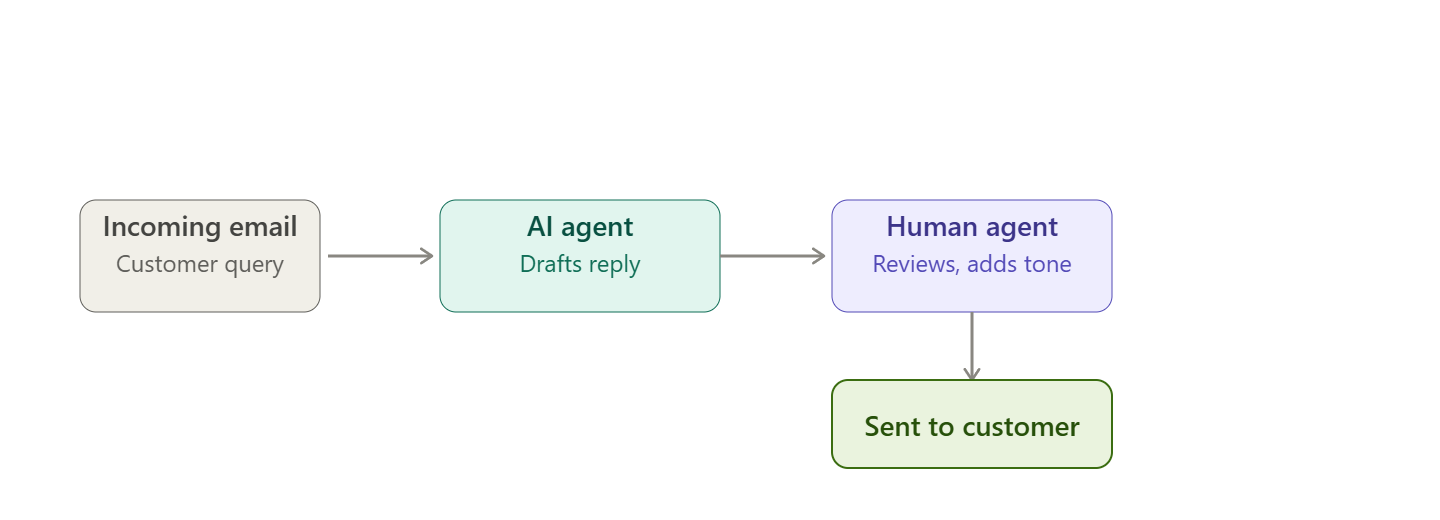
For example, in a customer support team, an AI agent can read incoming emails. It drafts the response and pulls customer history. The human agent reviews the draft, adds a personal touch, and approves the send. This process speeds up response times while keeping the human touch.
Enterprise-Wide Benefits of an Integrated Framework
When you integrate AI deeply, you unlock massive benefits. You create AI-first business processes that run faster and cost less. Your teams stop wasting time on repetitive work. They focus on creative problem-solving and customer relationships.
You also get better business insights. Because your data flows through a central model, you can predict market changes faster. This agility helps you stay ahead of competitors who still rely on manual processes.
Addressing Key Implementation Challenges and AI Governance
Every major shift comes with challenges. You might face resistance from employees who fear losing their jobs. You might also worry about data leaks or biased AI decisions. This is why AI governance and compliance must be part of your design from day one.
Set up clear guidelines on what data the AI can access. Create review boards to check AI outputs for accuracy. Train your staff on ethical AI use. When employees understand the guardrails, they feel safer using the technology.
Let us look at another example. A regional bank wanted to use AI for loan approvals. Instead of just buying software, they built a strict compliance workflow. The AI analyzed applications but flagged complex cases for human review. The bank kept full transparency for auditors while cutting approval times by half.
Industry Use Cases: Real-World AI Transformation
Let us look at how different industries use these models to transform.
In marketing, teams use integrated models to personalize customer journeys. The system tracks user behavior, updates the CRM, and sends tailored content automatically.
In healthcare, clinics use AI to schedule patients and suggest treatment plans based on medical history. This reduces the administrative burden on doctors.
In finance, firms automate invoice processing and fraud detection by connecting transaction data directly to risk analysis systems.
In manufacturing, factories connect IoT sensors to AI models. The system predicts machine failures and orders replacement parts before a breakdown occurs.
In retail and SaaS, brands use AI to manage inventory and monitor user health. The system alerts managers when a customer shows signs of churning.
The Indian Business Context: Opportunities and Localization
The landscape of Indian enterprise AI adoption is growing rapidly. Indian businesses face unique challenges, like managing diverse local languages and varying internet speeds. To succeed, Indian companies must localize their AI systems. You need models that understand regional dialects and local consumer habits.
For example, a retail brand in Mumbai might need AI that processes customer queries in Hindi, Marathi, and English. Building a local operating model helps you capture this massive market.
Consider an Indian logistics company that uses localized AI to optimize routes. The AI processed real-time traffic and local address formats. This system cut fuel costs by 15% and improved delivery times across major hubs.
Future Trends: SaaS Stack Consolidation and Agentic Workflows
The future of business software is changing. Right now, companies use dozens of different SaaS tools. This tool sprawl is expensive and messy. We are now seeing a major shift toward SaaS stack consolidation with AI.
Instead of buying ten different tools, companies will use one AI-native platform. This platform will run multiple agentic workflows to handle different tasks. Your software stack will become simpler, cheaper, and much more powerful.
How Collide Solutions Helps Build Your Scalable System
You do not have to build this complex system alone. Collide Solutions helps businesses transition from basic workflow automation strategies to fully integrated models. We do not just hand you a piece of software. We work with you to redesign your roles and processes.
Our team helps you overcome generative AI implementation challenges. Through our enterprise AI consulting services, we build a custom blueprint for your business. Explore our case studies page to see how we help other brands achieve true transformation.
Conclusion: Embracing the Shift to an AI-First Enterprise
The era of standalone AI tools is coming to an end. To win in the modern market, you must think bigger. You need a structured, scalable system that puts intelligence at the core of your business.
Start building your operating model today. Focus on your data, redesign your workflows, and empower your people. The future belongs to the AI-first enterprise.