
Digital advertising changes incredibly fast. In 2026, managing paid search campaigns manually is no longer enough to stay ahead of your competition. Advertisers now rely on artificial intelligence to build, manage, and scale their campaigns.
Using smart automation helps you reach the right audience at the perfect moment. This guide explores how modern tools and strategies can transform your marketing results. Let us dive into how this technology is reshaping paid search.
How AI Improves Google Ads Performance for Modern Businesses
Modern brands face rising ad costs and fierce competition. Manual campaign management takes too much time and often misses hidden patterns in user search behavior. AI Google Ads tools solve this problem by analyzing millions of data points in real time.
This technology allows you to adjust budgets and bids instantly. This shift helps businesses reduce wasted spend and focus on high-value conversions. If you want to understand the basics first, check out our blog post about Google Ads bidding strategies for beginners.
Core AI Features in Google Ads
Google Ads machine learning powers the platform's most effective features today. Three main pillars drive this automation: Smart Bidding, Performance Max, and Responsive Search Ads.
Smart Bidding uses automated bidding strategies to optimize for conversions in every single auction. It looks at signals like user location, time of day, and device to set the best bid.
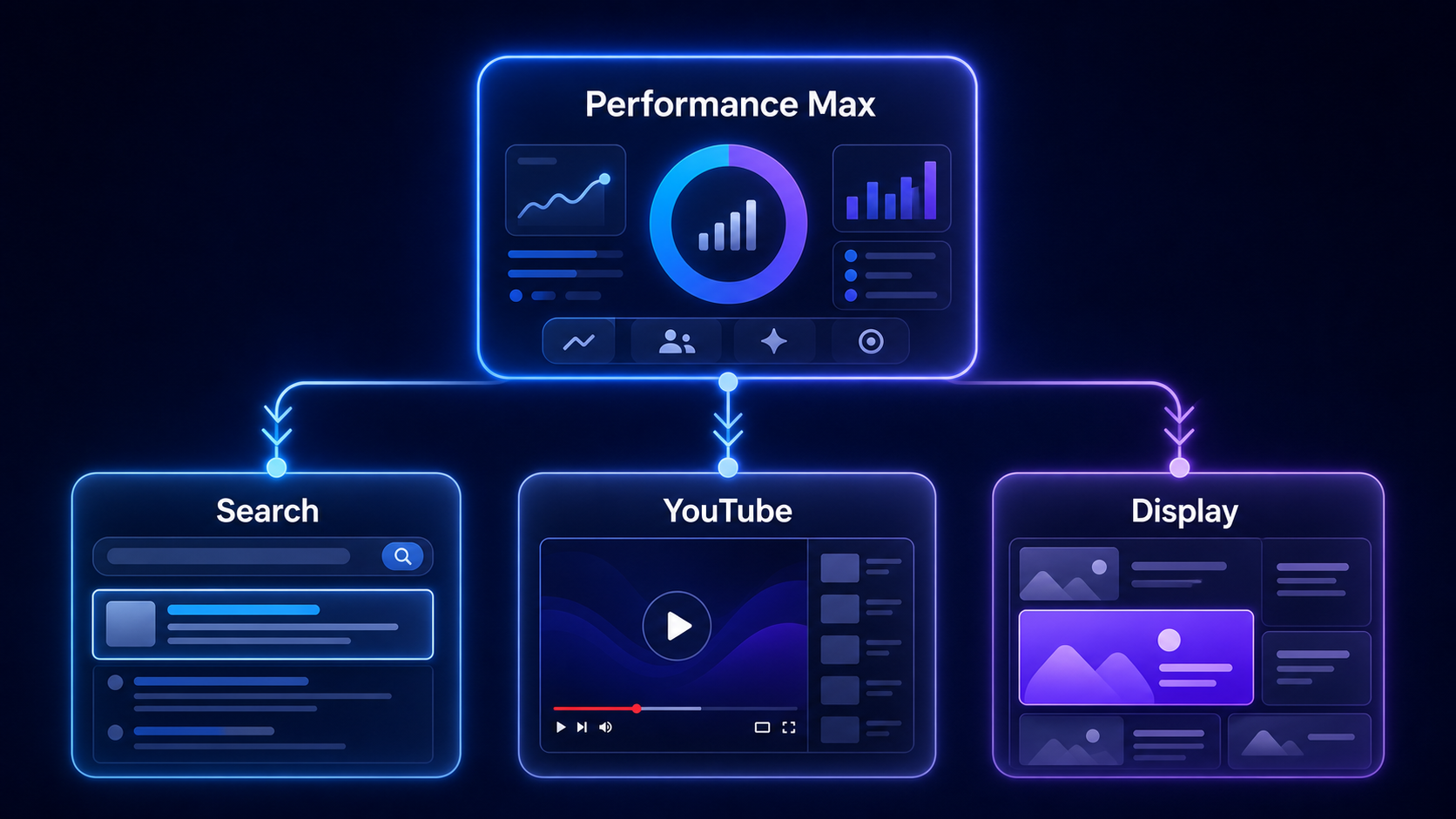
Performance Max campaigns allow advertisers to access all Google Ads inventory from a single campaign. This feature uses AI to find valuable customers across YouTube, Search, Display, and Maps.
Responsive Search Ads use AI ad copy generation to test different headline and description combinations. The system automatically displays the best-performing combinations to searchers.
Advanced Automation in Google Ads
Google Ads Automation goes beyond simple bidding. It also streamlines keyword research, budget management, and ad creation. Dynamic Search Ads use your website content to target relevant searches automatically.
This feature ensures you do not miss valuable search traffic even if you do not target those exact keywords. Using predictive analytics in PPC can forecast future performance based on historical data.
The system automatically shifts budget to campaigns that are likely to drive the highest return. This proactive budget allocation keeps your campaigns profitable during seasonal shifts.
Key Metrics Enhanced by AI
AI campaign optimization directly impacts your bottom line by improving key performance metrics. First, AI improves your Click-Through Rate (CTR).
By matching highly relevant ad copy to specific search queries, users are more likely to click. Second, it raises your Quality Score. Google rewards ads that offer great user experiences with lower costs per click.
Finally, AI maximizes your Return on Ad Spend (ROAS). By bidding higher on users who are likely to buy, you secure more revenue from your budget. To track these metrics accurately, read our guide to setting up conversion tracking for digital marketing.
Industry-Specific Examples: AI Google Ads in Action
E-commerce Industry
An online fashion brand in Mumbai used Performance Max to promote its new summer collection. The AI analyzed customer purchase history and automatically targeted high-intent shoppers across YouTube and Google Search. By optimizing audience targeting and ad placements in real time, the campaign increased online sales by 35% within one month, demonstrating how AI can drive higher conversions and improve Return on Ad Spend (ROAS).
Real Estate Industry
A real estate developer in Bangalore used predictive analytics in PPC to identify potential home buyers. The AI targeted users who had recently searched for home loans, residential properties, or visited real estate websites. This data-driven targeting helped the developer reach more qualified leads and reduced the cost per lead by 25%, making the advertising budget more efficient.
Education Industry
A test preparation center in Delhi used Smart Bidding and automated bidding strategies to promote its weekend coaching batches. The AI automatically increased bids during peak evening search hours when students were most likely to search for coaching classes. As a result, the institute achieved 40% more student registrations without increasing its daily advertising budget, showing how AI can maximize campaign performance while controlling costs.
Manual Google Ads Management vs. AI-Powered Optimization
Many marketers wonder if they should trust AI or stick to manual methods. Manual PPC management requires bid adjustments weekly or daily based on past performance, manual A/B testing of static ads, constant keyword monitoring, and significant time investment.
In contrast, AI-powered optimization adjusts bids in real time during every auction, automatically tests thousands of ad variations, predicts user intent, filters irrelevant traffic, scales campaigns across multiple Google channels using Performance Max, and requires only strategic monitoring instead of hours of manual work.
Top AI Tools for Google Ads
Google Ads AI – Google's built-in AI tool that helps with real-time bidding, automated campaign optimization, and asset generation.
Gemini – Google's conversational AI that helps marketers brainstorm creative ad copy, generate campaign ideas, and plan campaign structures.
ChatGPT – An AI writing assistant that helps create compelling ad copy, engaging headlines, product descriptions, and marketing content quickly.
Optmyzr – A third-party PPC automation tool that helps identify wasted ad spend, automate optimization tasks, and manage budgets across multiple Google Ads accounts.
AdCreative.ai – An AI-powered platform that generates high-converting ad creatives, banners, and visuals in seconds to improve campaign performance.
SEMrush – A digital marketing tool that helps advertisers track competitor keywords, discover new search trends, and identify valuable keyword opportunities for AI-powered campaigns.
Common Mistakes to Avoid When Using AI in PPC
AI is powerful, but it is not magic. Beginners often make critical mistakes when trusting automation blindly. One common mistake is budget mismanagement. If you set your daily budget too low, the AI cannot gather enough data to learn effectively.
Another error is ignoring conversion tracking. If you provide inaccurate or incomplete conversion data, the AI will optimize for the wrong actions, leading to poor campaign performance. For professional assistance in avoiding these issues, consider working with a PPC campaign management expert.
Best Practices and Expert Tips for Beginners
To achieve the best results from AI-powered Google Ads, provide high-quality headlines, descriptions, images, and videos so the AI has enough creative assets to test.
Set realistic daily budgets, ideally at least ten times your target cost per acquisition, to help Google's machine learning collect sufficient data.
Allow two to three weeks for the learning phase before making major campaign changes.
Monitor search term reports regularly to identify irrelevant searches and add negative keywords, ensuring your budget focuses only on high-intent traffic.
Future AI Trends in PPC Advertising
Looking beyond 2026, AI will continue transforming search engine marketing. Generative Engine Optimization (GEO) is changing how people search as AI-powered search engines increasingly provide direct answers to user queries.
PPC managers must adapt by optimizing campaigns for conversational search behavior. Voice search and visual search will become more deeply integrated into Google Ads.
Advertisers who prepare optimized creative assets and strategies for these emerging search formats today will be better positioned for future success. Understanding the relationship between SEO and PPC will become even more important as AI reshapes digital marketing.
Frequently Asked Questions (FAQ)
Does AI replace human PPC managers?
Answer: No. AI handles repetitive tasks and data analysis. Human managers are still needed for strategy, creative direction, and budget decisions.
How long does it take for Smart Bidding to learn?
Answer: It usually takes 7 to 14 days for Google's machine learning model to complete its learning phase.
Can small businesses use AI in Google Ads?
Answer: Yes. Small businesses can benefit greatly from Smart Bidding and Responsive Search Ads to compete with larger brands on a budget.
Conclusion and Actionable Next Steps
Artificial intelligence has permanently transformed digital advertising. By using features such as Smart Bidding, Performance Max, Responsive Search Ads, and predictive analytics, businesses can save time, reduce wasted ad spend, improve targeting, and maximize conversions.
Rather than trying to outperform AI manually, marketers should combine automation with strategic oversight. Begin by implementing accurate conversion tracking, testing Responsive Search Ads, enabling Smart Bidding, and allowing the system sufficient time to learn.
Monitor campaign performance regularly, make data-driven improvements, and gradually scale your advertising budget as results improve. Businesses that embrace AI-powered Google Ads today will be better prepared to compete and grow in the increasingly automated digital advertising landscape.