
For the last two years, the working definition of AI in marketing was a prompt box. You asked for five headline variants, you read them, you picked one, and you pasted it into the ad account yourself. Every useful thing the model produced still needed a human to carry it the last mile. That definition is now out of date. Growth teams are setting a top-level target, something as blunt as "achieve a $50 CPA on Meta," and letting an autonomous agent handle the creative generation, the A/B testing, and the budget reallocation that gets them there.
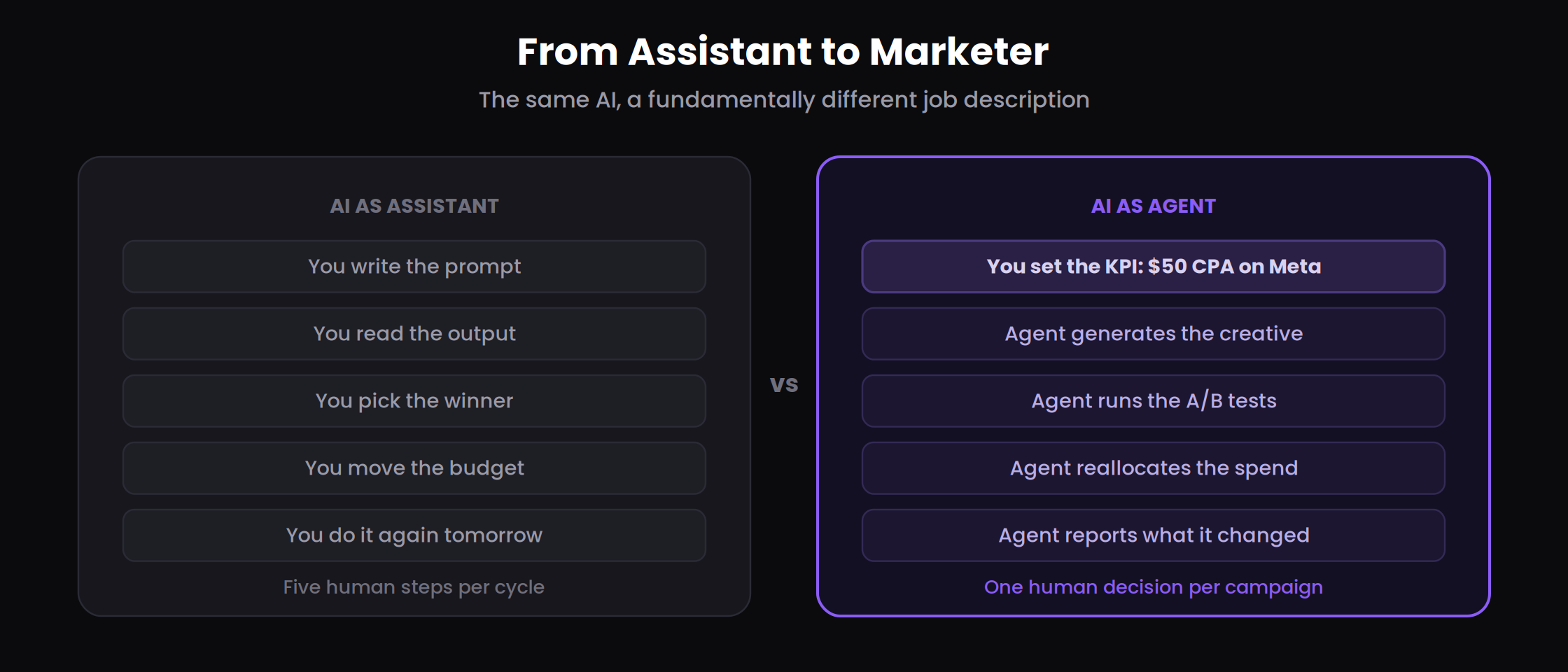
This is the difference between an assistant and a marketer. An assistant waits for instructions and returns text. An agent holds an objective, takes actions inside your ad accounts, observes what happened, and decides what to do next, without a human re-typing the same optimization every morning. Agentic AI marketing is not a better prompt. It is a different operating model for how campaigns get run.
Why 'Prompt and Response' Undersells Agentic AI
The prompt-and-response frame made sense when the model could only produce output, not take action. It could describe a good ad, but it could not launch one, read the result, or pause the loser. Every loop still closed through a person, which meant the speed of your optimization was capped by the speed of your team's calendar.
AI marketing agents remove that cap. Given account access, a clear KPI, and a set of guardrails, an agent can generate a creative variant, push it live, watch the cost per result for a statistically meaningful window, and shift budget away from what is not working, all inside a cycle measured in hours rather than a weekly optimization meeting. The marketer's job moves up a level: from executing the optimization to defining what a good outcome is and where the agent is not allowed to go.
That distinction matters because performance marketing has always been a compounding game. A team that resolves ten tests a week learns faster than a team that resolves two, and the gap widens every month. End-to-end campaign automation is less about saving a few hours and more about running the learning loop at a frequency a human team structurally cannot.
Four Ways Agentic AI Is Actually Running Campaigns
Pillar 1: Creative Generation That Never Stops Iterating
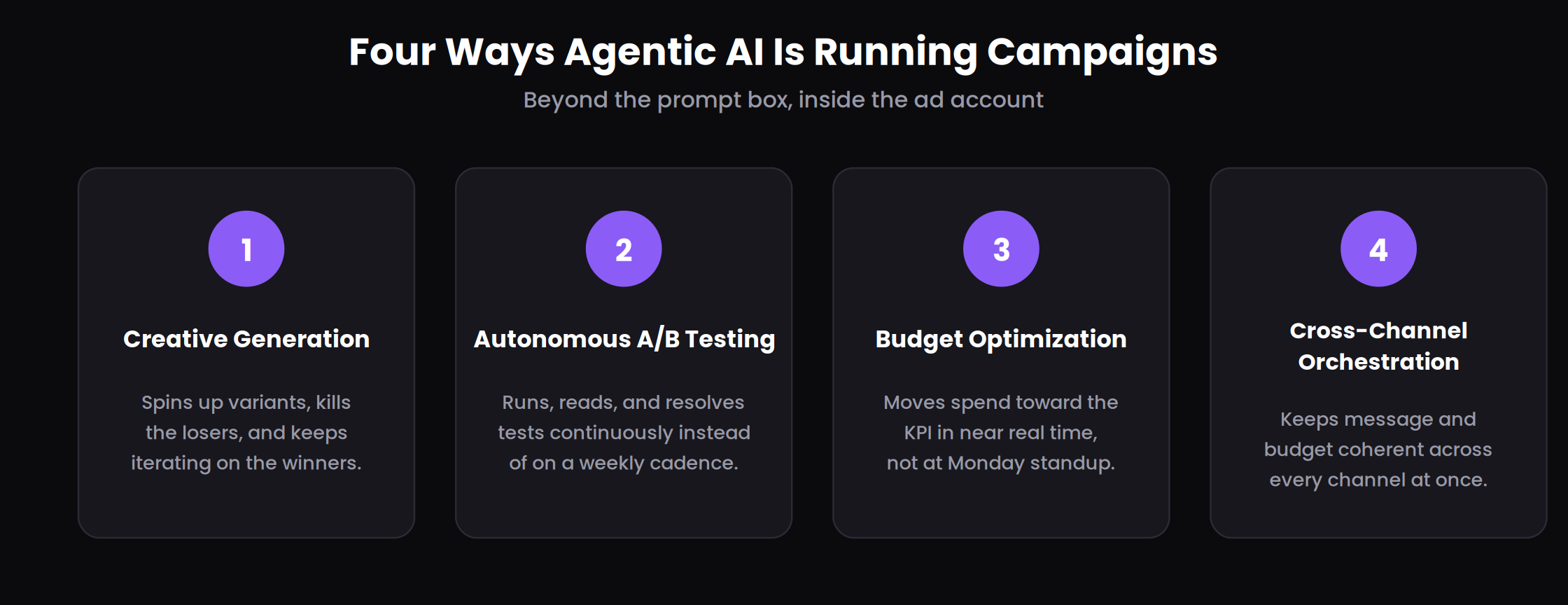
Creative is the highest-leverage variable in most paid accounts and the one that decays fastest. An agent treats it as a continuous process rather than a quarterly project: generate a batch of variants against the brief, ship them, let the data kill the underperformers, and generate the next batch informed by what survived. AI creative generation stops being a one-time asset drop and becomes a standing supply of tested concepts, which is exactly what fatigue-prone channels like Meta and TikTok demand.
Pillar 2: Autonomous A/B Testing at Machine Speed
Most teams run tests on a human cadence: set one up on Monday, check it on Friday, call it on the following Monday. An agent runs tests continuously, holds them to a predefined significance threshold, and resolves them the moment the data supports a call. Automated A/B testing also removes the quiet failure mode of manual testing, which is the test nobody remembers to check, still running three weeks later on a variant that lost in week one.
Pillar 3: Budget Optimization Against a KPI, Not a Schedule
Native platform bidding optimizes inside a campaign. An agent optimizes across them, and against the target you actually care about. Given a $50 CPA goal, it can pull spend from an ad set drifting to $80, push it toward one holding at $38, and pause the segment that has not converted in a meaningful window, continuously rather than at whatever hour the account manager happens to log in. AI budget optimization turns your CPA target from a number you report on into a constraint the system actively defends.
Pillar 4: Cross-Channel Orchestration Without a Coordinator
Multi-channel campaigns usually fail at the seams: search and social drift out of sync, the retargeting audience is stale, the landing page still references last month's offer. An agent working across connected channels can keep message, audience, and budget coherent as one system, because it is not managing four dashboards through four different people. This is where autonomous campaign optimization starts replacing the coordination overhead that scaled linearly with channel count.
The Shift From Prompting to Delegating
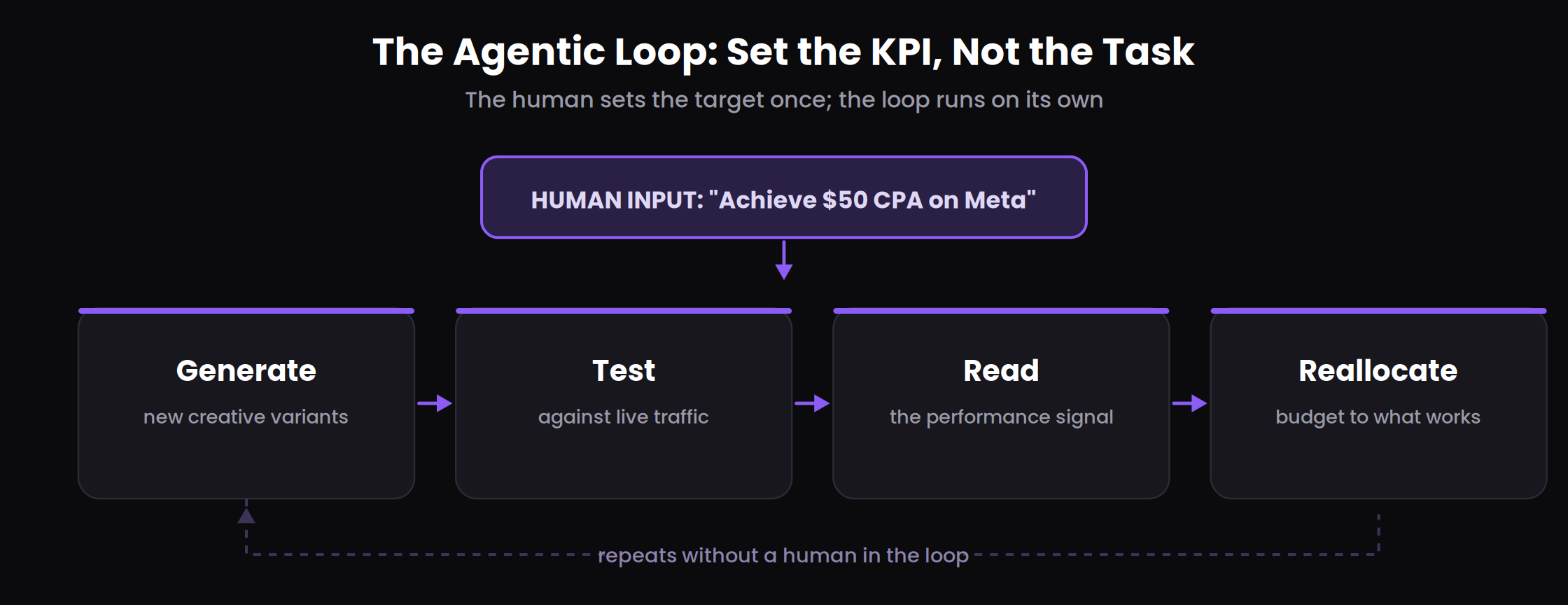
In the old model, the marketer wrote a prompt and evaluated the reply. In the new model, the marketer defines an outcome and reviews the decisions an agent already made. That is a different relationship with the tool, and it demands a different skill. Prompt craft still helps at the margins, but the bigger advantage now goes to the marketer who can specify a KPI cleanly, expose the right data, and set guardrails that make autonomy safe.
The failure mode of agentic marketing is almost never that the agent could not act. It is that it was pointed at the wrong objective. An agent told to minimize CPA will happily find you cheap conversions from an audience that never renews. Choosing the metric, and knowing which downstream metric keeps it honest, is now the highest-value thing a growth lead does.
Guardrails: What Still Belongs to the Human
Autonomy without limits is not a strategy, it is an incident waiting to be explained to a client. Effective deployments hard-code a small set of boundaries: a daily and campaign-level spend cap the agent cannot exceed, brand and claims rules that gate what creative can go live, and escalation thresholds that pause the loop and page a human when performance moves outside an expected band.
Two things in particular stay with people. The first is brand judgment: what the company is willing to say and how it wants to sound is a decision, not an optimization target. The second is strategic direction, meaning which market to enter, which product to push, which customer is worth acquiring at all. An agent is very good at reaching a target and has no opinion about whether the target was the right one.
How Collide Approaches Agentic Marketing
This is the operating model behind Collide's approach to campaign work. Agents are not bolted on as a creative-generation shortcut at the end of an otherwise manual process; they are given the KPI, the account access, and the guardrails up front, and the team's time moves to defining objectives, setting the constraints, and reviewing what the system decided. Creative supply runs continuously instead of in campaign-shaped batches, tests resolve on data rather than on the calendar, and budget follows performance without waiting for a Monday meeting. The result is a growth operation that learns at a speed a purely manual team cannot match, with a human owning every decision that is actually a judgment call.
Your Roadmap to Agentic Campaigns
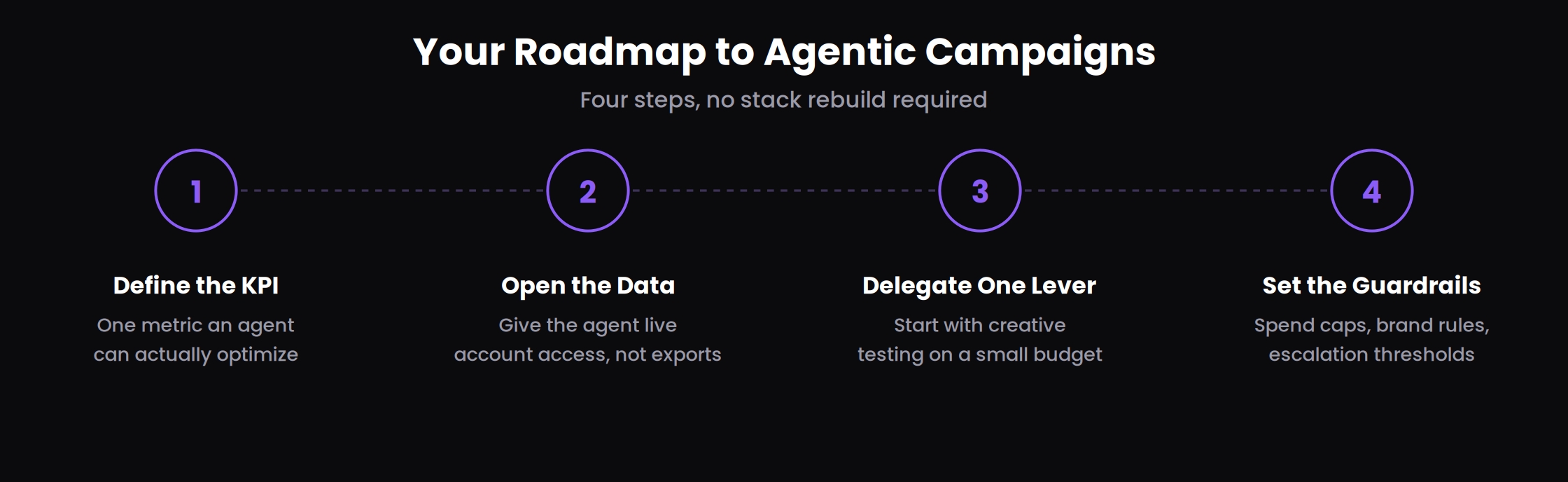
Moving to this model does not require rebuilding your martech stack. Four steps get a team most of the way there.
Step 1: Define a KPI an Agent Can Actually Optimize
Pick one primary metric that is measurable in-platform, tied to real business value, and unambiguous. "Achieve a $50 CPA on Meta" works. "Improve brand awareness" does not. Pair the primary target with one guardrail metric, such as a minimum conversion volume or a downstream retention floor, so the agent cannot hit the number by optimizing into a worthless audience.
Step 2: Give the Agent Live Data, Not Exports
An agent optimizing against a CSV you emailed it is just a slower analyst. Connect it to the ad platform, the analytics layer, and ideally the CRM, so it is reading the same numbers you are, at the same time. The value of end-to-end campaign automation comes almost entirely from closing the loop between action and observed result.
Step 3: Delegate One Lever on a Small Budget
Do not hand over the whole account on day one. Pick a single lever, usually creative testing on one campaign with a contained budget, and let the agent own it end to end for a few weeks. You get a real read on both performance and behavior, and the downside is capped at an amount nobody has to defend in a QBR.
Step 4: Write the Guardrails Before You Expand Scope
Before extending the agent to more budget or more channels, put the limits in writing: spend caps, approved claims, audience exclusions, and the conditions that trigger a human review. Expanding autonomy is a decision you should be able to make deliberately, because the guardrails already exist rather than because nothing has gone wrong yet.
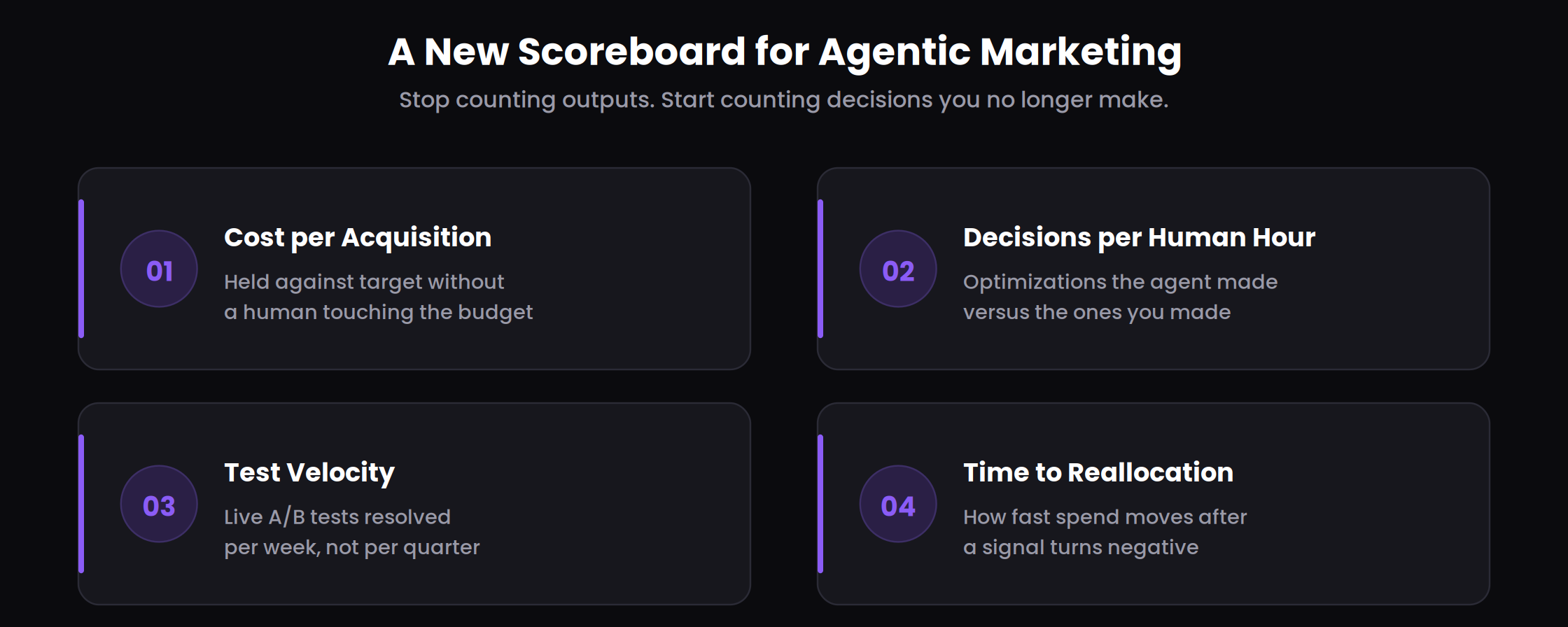
Measuring the Impact: A New Scoreboard for Agentic Marketing
Cost per acquisition against target: whether the KPI holds without a human intervening in the budget.
Decisions per human hour: how many optimizations the agent made versus how many the team made by hand.
Test velocity: how many A/B tests are launched and resolved per week, not per quarter.
Time to reallocation: how long spend keeps flowing to an ad set after its performance signal turns negative.
Conclusion
Generating copy was never the ceiling on what AI could do for marketing, it was just the first thing that fit inside a chat window. Teams that stop at generated headlines are using AI as an assistant. Teams that hand it a KPI, live account access, and a clear set of limits are using it as a marketer, and the difference shows up in how fast the account learns.
The question worth asking is no longer "what can AI write for this campaign?" It is "what can AI run for this campaign, and what do I need to decide before I let it?" Answer that well, and campaign performance stops being a function of how many hours your team can spend inside the ad manager.