
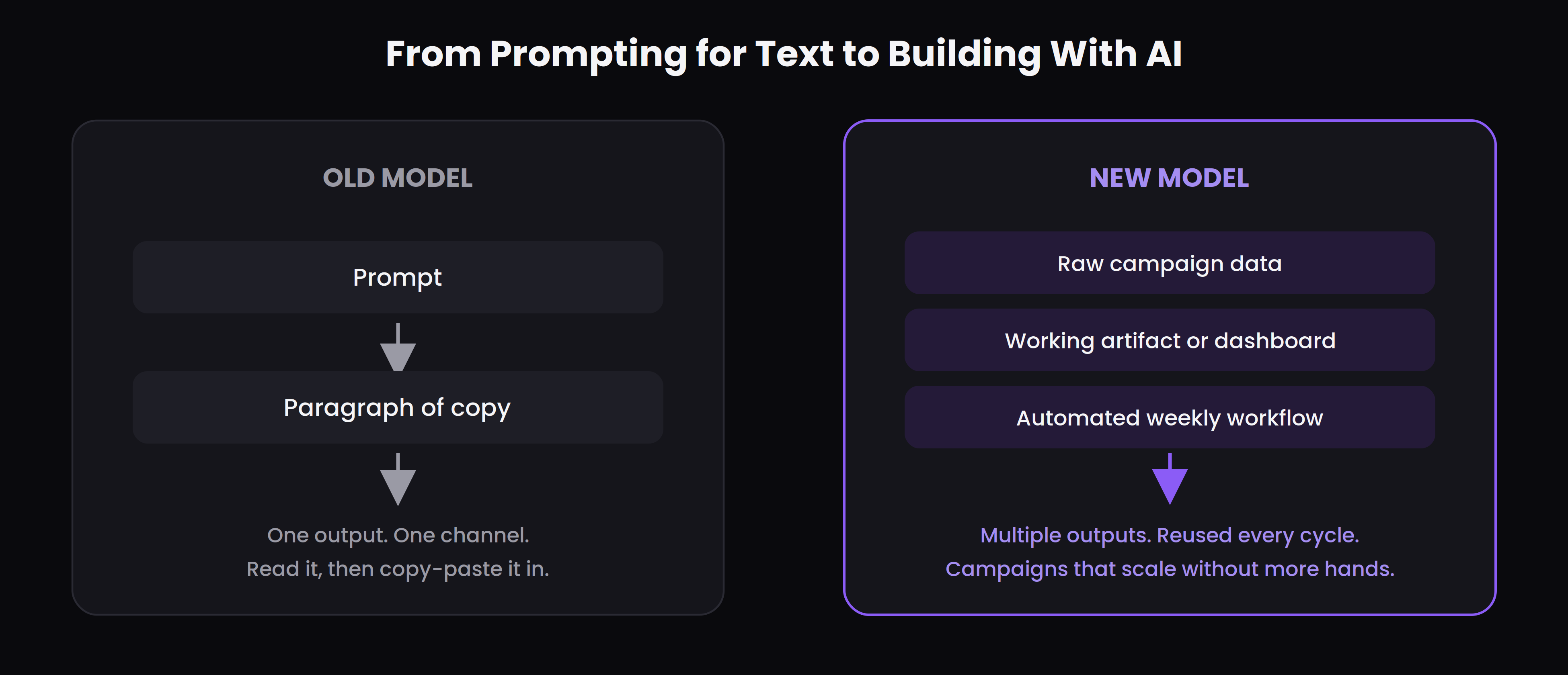
For most of the last two years, the story on generative AI in marketing was simple: type a prompt, get a paragraph. Claude wrote the caption, the email subject line, the ad copy. That story is now out of date. Marketers running real campaigns are asking Claude to pull apart a spreadsheet of campaign data, build a working dashboard they can hand to a client, and automate the reporting they used to do by hand every Monday morning. Copywriting was the entry point. Data analysis, artifact creation, and campaign automation are where the actual leverage lives.
If your team still treats Claude as a copy generator, you are using a small fraction of what modern AI marketing tools can do. This is the shift from prompting for text to building with AI, and it is changing how growth teams operate.
Why 'Just a Copywriter' Undersells Modern AI
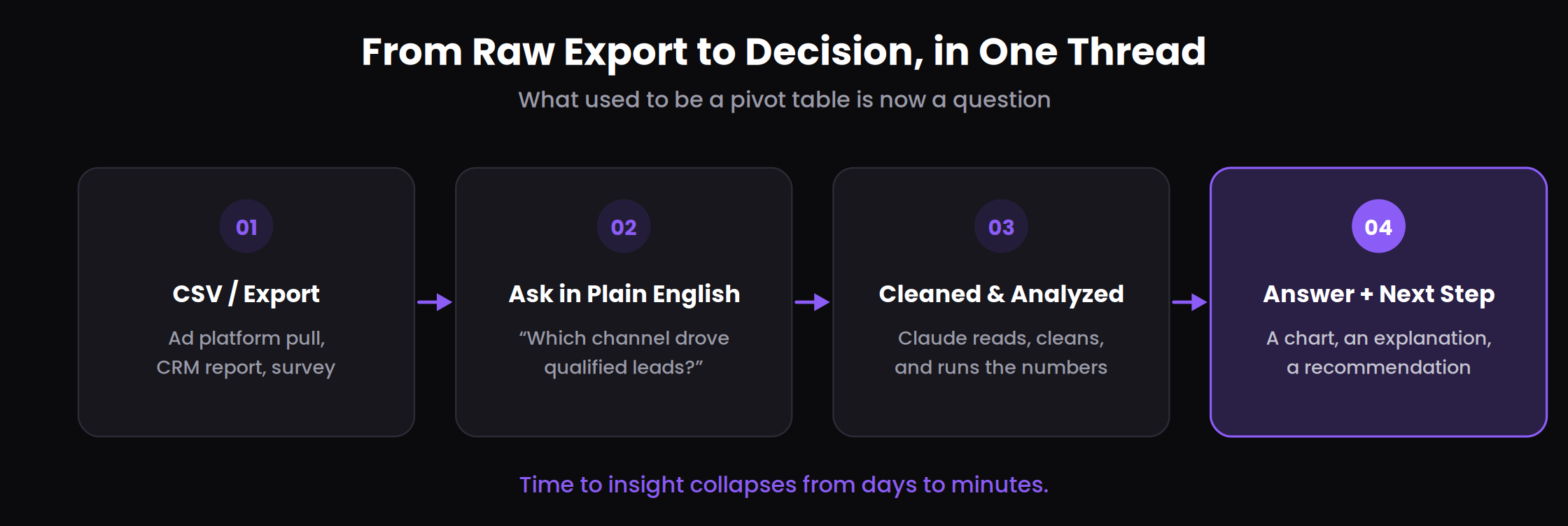
The copywriting frame made sense when the only interface was a chat box and the only output was text. But Claude AI for marketers now spans data analysis, code generation, and interactive artifact creation inside the same conversation. A marketer can upload a raw CSV of ad spend, ask Claude to find the underperforming segment, and walk away with a chart, a written explanation, and a next-step recommendation, all without opening a separate analytics tool.
That matters because marketing work was never really about words. It was about decisions: which audience to cut, which creative to scale, which channel is quietly bleeding budget. Words were just the output format teams were stuck with. AI-powered marketing campaigns now run on a wider set of outputs, and copy is only one of them.
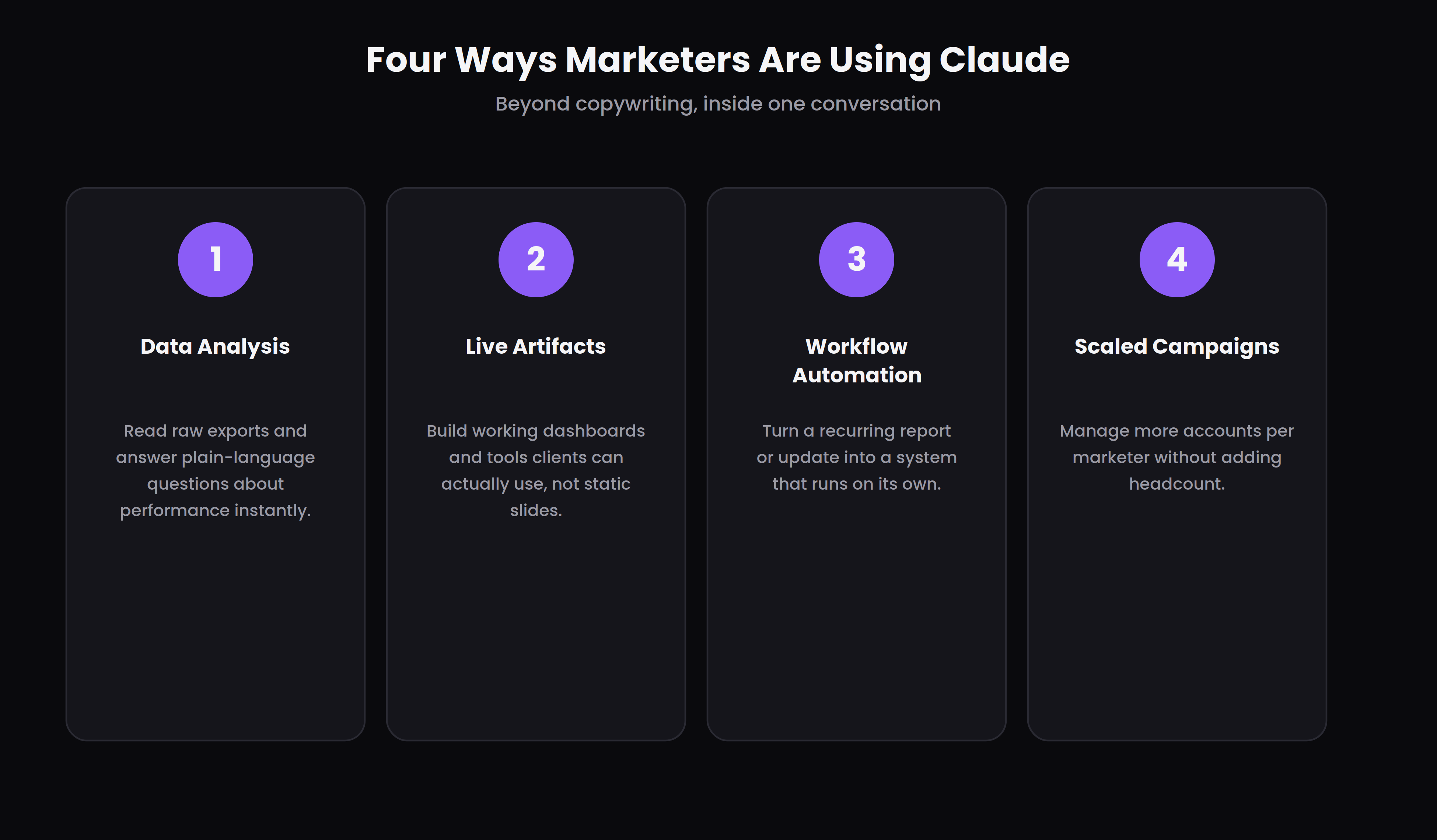
Four Ways Marketers Are Actually Using Claude
Pillar 1: Data Analysis at the Speed of Conversation
Marketing generates data faster than most teams can read it: platform exports, CRM pulls, survey responses, funnel metrics. Claude can read a raw file, clean it, and answer plain-language questions about it directly. Instead of building a pivot table to check which channel drove the most qualified leads last quarter, a marketer can simply ask. This is where AI data analysis for marketing stops being a nice-to-have and starts replacing the analyst's first draft.
Pillar 2: Building Live Artifacts, Not Just Documents
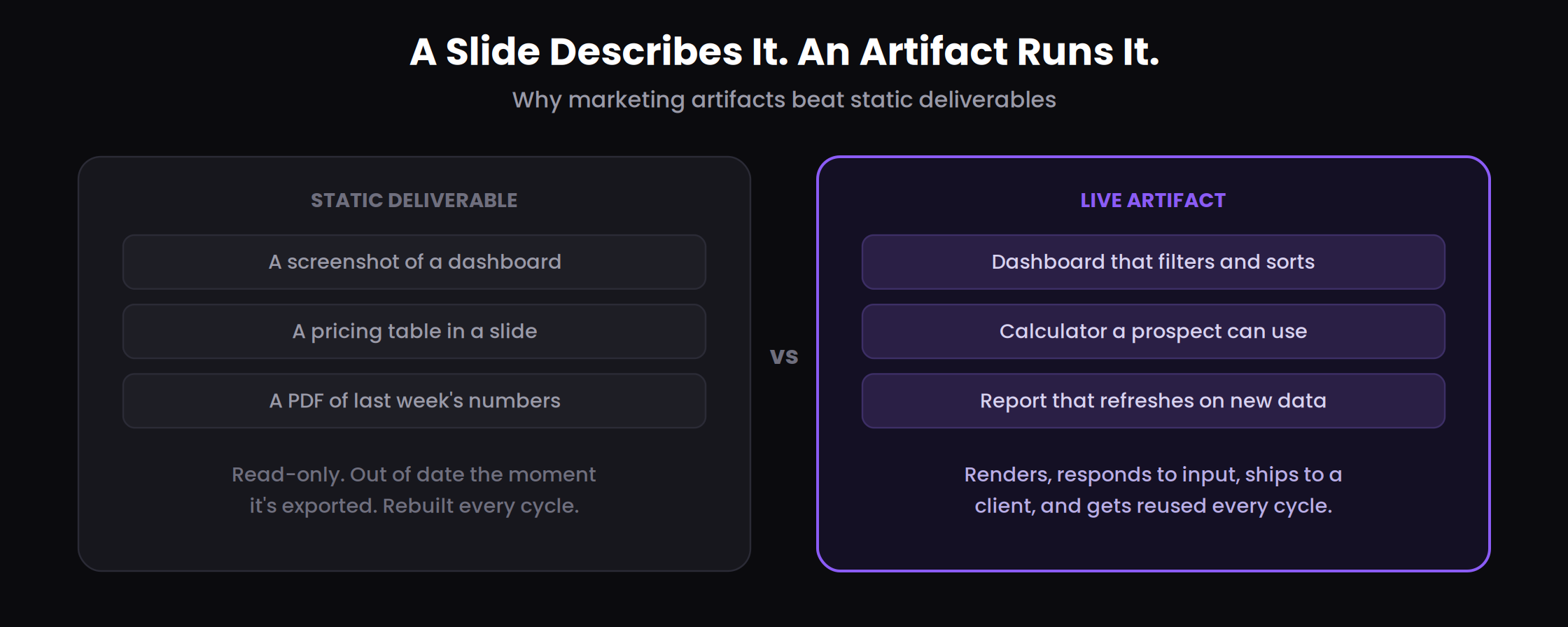
An artifact is a working piece of software Claude builds and hands back: an interactive dashboard, a calculator a prospect can use on a landing page, a mock-up of a campaign microsite. These marketing artifacts are not static slides. They render, respond to input, and can be shared or embedded directly. A marketer explaining a pricing model no longer needs a designer and a developer in the loop for a first version; Claude builds one that actually works.
Pillar 3: Automating the Marketing Workflow End-to-End
The most valuable use of Claude in a growth team is rarely a single great output. It is a repeatable workflow: pull last week's numbers, summarize performance against target, flag anomalies, and draft the update for the client, on a schedule, without a human re-typing the same prompt every Monday. AI marketing automation turns a recurring task into a system, which frees the team to spend that time on strategy instead of status updates.
Pillar 4: Scaling Campaigns Without Scaling Headcount
Agencies and in-house teams both hit the same wall: campaign volume grows faster than the team does. Claude lets a lean team run analysis, build assets, and manage reporting for far more accounts than the headcount would traditionally support. Scaling marketing campaigns with AI is less about replacing marketers and more about removing the ceiling on how much one marketer can competently manage.
The Shift From Prompting to Building
In the old model, a marketer wrote a prompt and read the reply. In the new model, a marketer describes an outcome and Claude produces something usable: a chart, a document, a functioning tool. That is a fundamentally different relationship with AI. It moves Claude from a drafting assistant to something closer to a junior analyst and a junior developer working in the same conversation, on the same data, in real time.
This is also why the skill that matters most is shifting. Writing a good prompt still helps, but the bigger advantage now goes to marketers who know what to ask for: which data to hand over, what the artifact needs to do, and where automation actually removes work instead of just moving it around.
How Collide Approaches AI-Powered Marketing
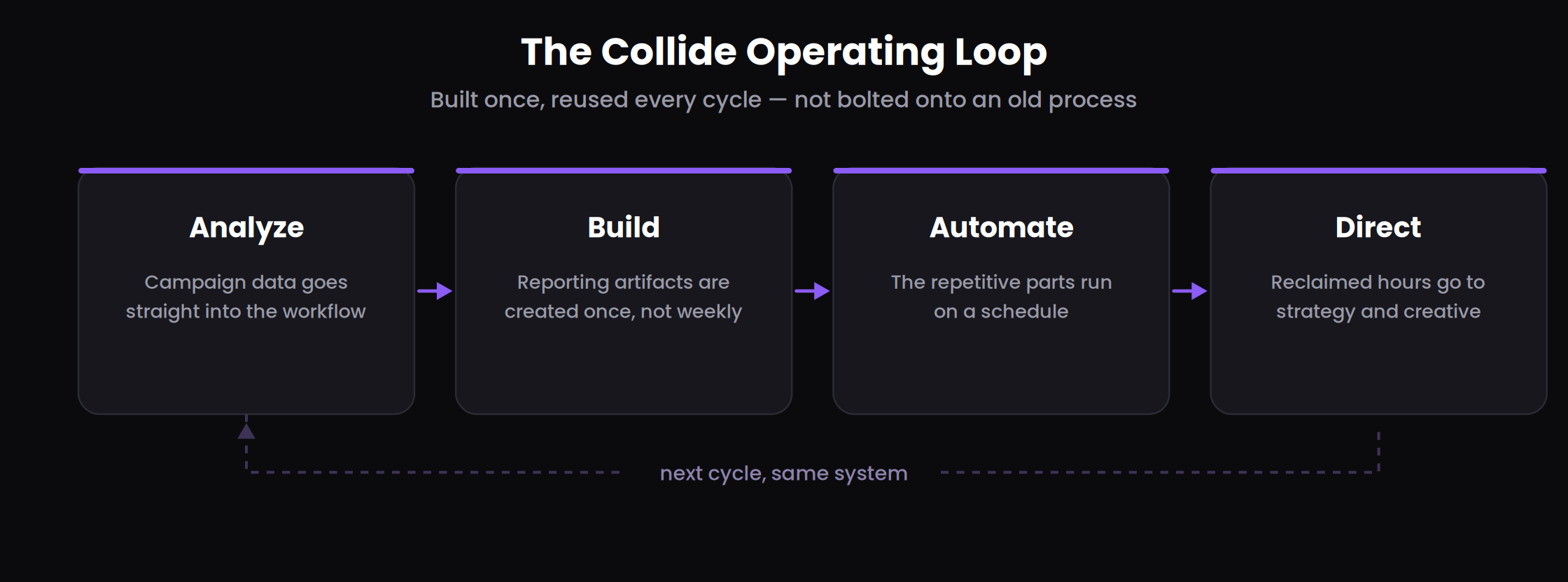
This is the operating model behind Collide's approach to campaign work. Collide does not treat Claude as a caption generator bolted onto an existing process. Campaign data gets analyzed directly inside the workflow, reporting artifacts are built once and reused every cycle, and the repetitive parts of content production and performance tracking are automated so the team's time goes toward strategy and creative direction, not manual reporting. The result is a content and growth operation that can move at a volume a purely manual team cannot match.
Your Roadmap to Working This Way
Adopting this approach does not require rebuilding your stack overnight. Four steps get a team most of the way there.
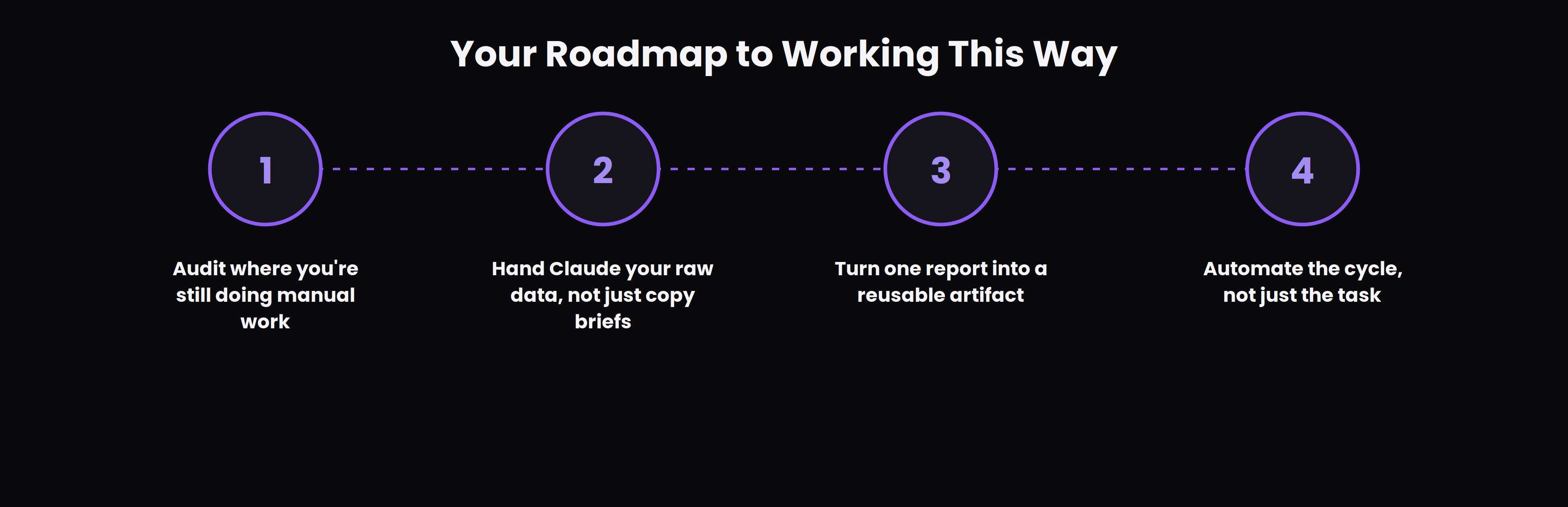
Step 1: Audit Where You're Still Doing Manual Work
List every recurring marketing task that involves opening a spreadsheet, copying numbers into a deck, or re-writing the same weekly update. Each one is a candidate for AI marketing automation.
Step 2: Hand Your Data to Claude, Not Just Your Copy Briefs
Start feeding Claude the raw exports: ad platform data, CRM reports, survey results. Ask it questions directly instead of building the chart yourself first. This is the fastest way to see the gap between using Claude for words and using it for AI data analysis.
Step 3: Turn One Report Into a Reusable Artifact
Pick your most frequently repeated deliverable, a client dashboard, a weekly performance summary, a lead-scoring view, and build it once as an artifact. Reuse it every cycle instead of rebuilding it from scratch.
Step 4: Automate the Cycle, Not Just the Task
Once a workflow works reliably by hand, script the repeatable parts: the same pull, the same analysis, the same draft, on the same schedule. This is where scaling marketing campaigns with AI actually shows up in hours saved.
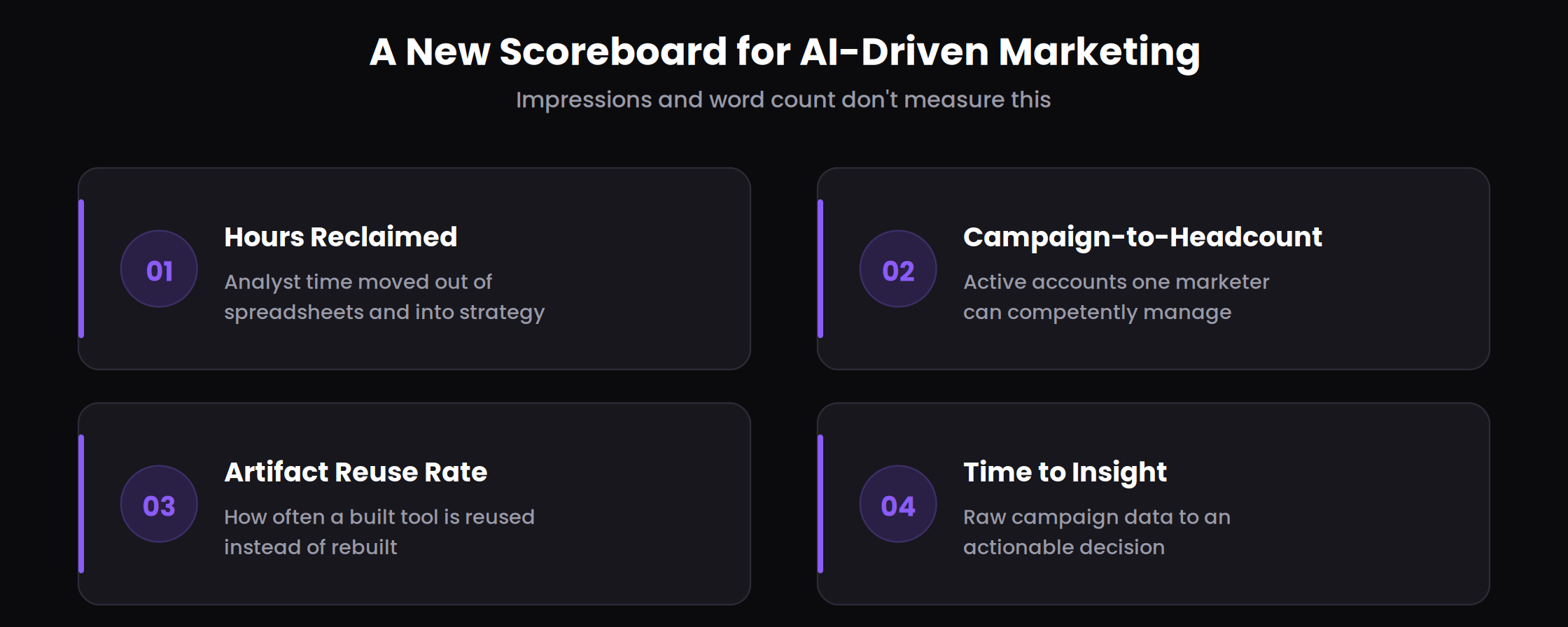
Measuring the Impact: A New Scoreboard for AI-Driven Marketing
Hours reclaimed from manual reporting: how much analyst and marketer time moved from spreadsheets to strategy.
Campaign-to-headcount ratio: how many active accounts or campaigns each team member can competently manage.
Artifact reuse rate: how often a built dashboard or tool gets reused instead of rebuilt from scratch.
Time to insight: how long it takes to go from raw campaign data to an actionable decision.
Conclusion
Copywriting was never the ceiling on what AI could do for marketing, it was just the first thing teams noticed. Marketers who stop at generated captions are using Claude as a tool. Marketers who bring it their data, ask it to build working artifacts, and let it run the repeatable parts of the workflow are using it as an operating system for growth.
The question worth asking is no longer 'what can Claude write for us?' It is 'what can Claude build, analyze, and run for us?' Answer that well, and scaling campaigns stops being a headcount problem.