
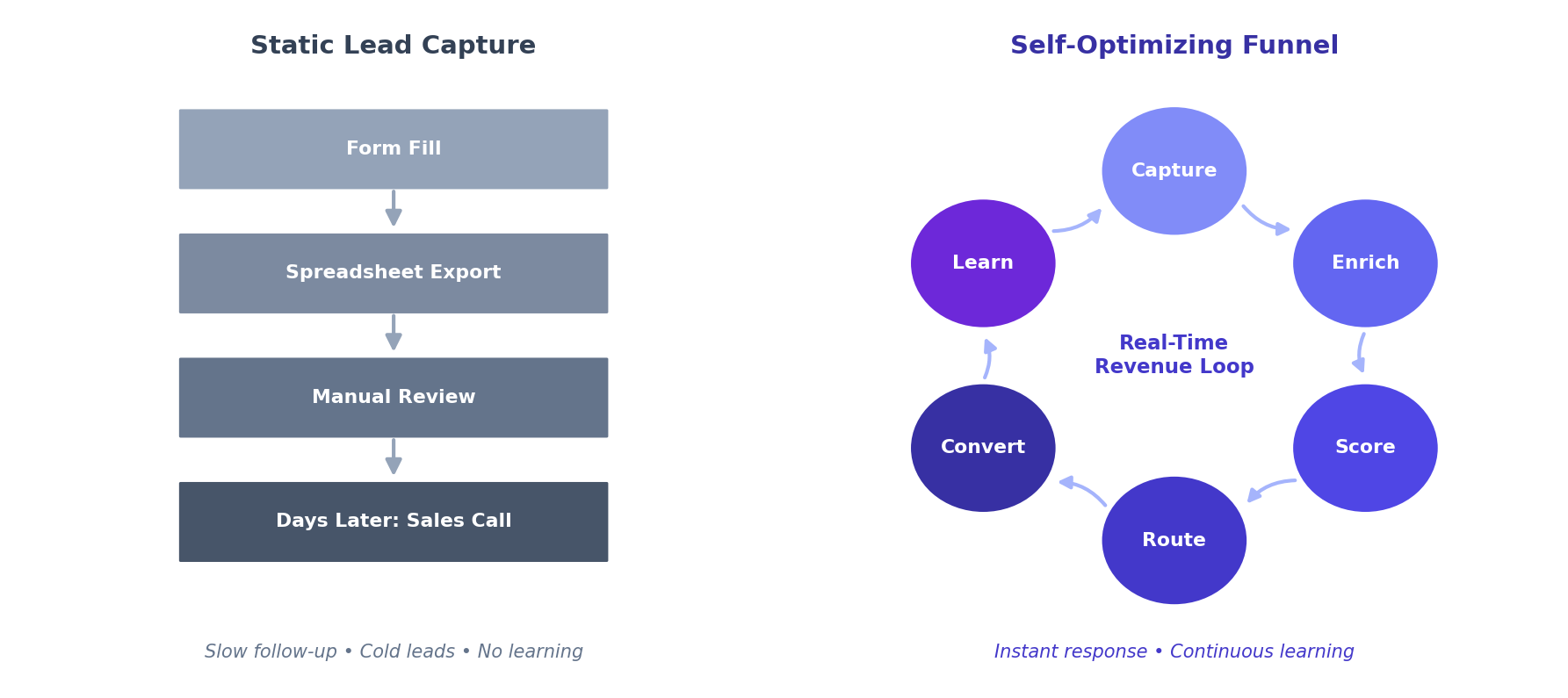
For years, lead generation meant one thing: get the form fill. Companies spent fortunes driving traffic to landing pages, collected email addresses, and called it a pipeline. Then the leads sat in a spreadsheet. Sales called them three days later. Most never answered.
That model is dead. Modern lead gen is not about forms. It is about what happens in the sixty seconds after the form. The winners are building autonomous revenue systems: funnels that score, enrich, and route leads in real time, and then learn from every closed deal to get better on their own.
Why Static Lead Capture Is Leaking Revenue
The traditional funnel treats a lead like a business card. Someone fills a form. The data lands in a list. A marketer exports it. A rep works through it when they have time. Every step adds delay, and delay kills deals.
The research on this is brutal. A lead contacted within five minutes is dramatically more likely to convert than one contacted an hour later. Yet most companies take hours or days to respond. The lead who was excited on your pricing page at 2 PM has signed with a competitor by Friday.
Static capture has a second, quieter problem: it learns nothing. The form does not know which leads became revenue. The nurture sequence does not adjust when a segment stops converting. The same broken funnel runs month after month, and nobody can see where it leaks.
What Is an Autonomous Revenue System?
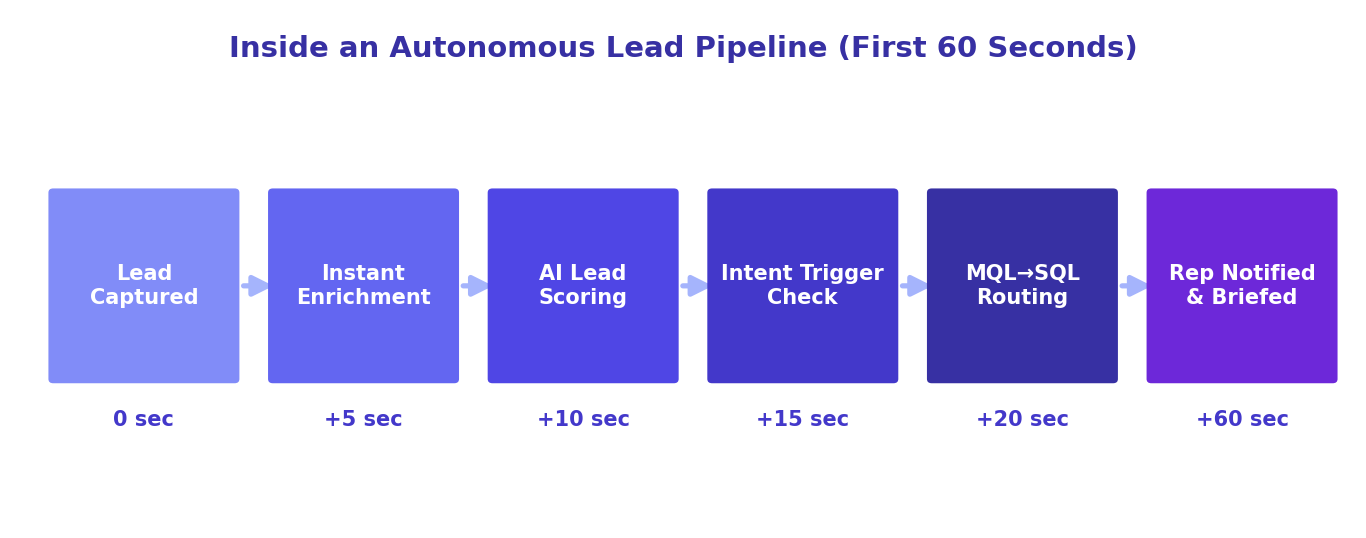
An autonomous revenue system replaces that dead chain with a live loop. It is lead generation infrastructure where every stage, from first touch to CRM routing, runs automatically on shared data. Four capabilities define it.
Real-Time Lead Scoring
The moment a lead enters the system, it gets scored. Not by a static point checklist written two years ago, but by a model that weighs firmographics, behavior, and historical conversion patterns. A director at a 200-person SaaS company who visited your pricing page twice scores differently than a student downloading a template. The score exists before a human ever sees the lead.
Instant Enrichment
Forms should be short. Enrichment makes that possible. When a lead submits just a work email, the system instantly appends company size, industry, tech stack, and funding data from enrichment sources. The lead becomes a full profile in seconds. Sales never has to ask "so, tell me about your company" again.
Behavioral Intent Triggers
Buying intent shows up in behavior long before it shows up in a demo request. Someone views your pricing page three times in a week. An account opens every email in your comparison sequence. A trial user invites five teammates. Behavioral intent triggers watch for these signals and act on them automatically, launching a sequence, alerting a rep, or upgrading the lead's score in real time.
Automated MQL-to-SQL Routing
The MQL-to-SQL hand-off is where most funnels die. Marketing declares a lead qualified. Sales disagrees, or simply never sees it. Automated routing removes the argument. When a lead crosses the scoring threshold, the system creates the CRM record, assigns the right rep by territory or segment, and delivers a context brief: who they are, what they did, and why they scored. The rep starts the conversation already informed.
From Automation to Self-Optimization
Automation alone is not the endgame. Plenty of teams have automated a broken funnel, and it just fails faster. The real shift is self-optimization: the funnel closes the loop with revenue data and improves itself.
Here is what that looks like in practice. Every closed-won and closed-lost deal feeds back into the scoring model. If leads from a certain industry keep closing at twice the average rate, their scores rise automatically. If a nurture sequence stops converting, the system flags it and shifts leads to the better-performing path. Routing rules adjust as rep performance data accumulates.
This is the difference between a funnel you manage and a funnel that manages itself. Humans set the strategy and review the decisions. The system runs the experiments, reads the results, and tunes the machine continuously. Over time, the gap between a self-optimizing funnel and a static one compounds into a structural revenue advantage.
Why This Requires Infrastructure, Not Plugins
You cannot buy self-optimization as a plugin. A scoring tool that cannot see your CRM outcomes cannot learn from them. A routing app that cannot see behavioral data cannot act on intent. Self-optimizing funnels only work when capture, enrichment, scoring, routing, and revenue data live on one connected system.
This is exactly what Collide's Lead Generation Infrastructure is built for. Instead of stitching together a form tool, an enrichment API, a scoring plugin, and a routing app, Collide runs the entire pipeline on unified infrastructure. Leads are captured, enriched, and scored in real time, and Collide's CRM routing capabilities move qualified leads to the right rep automatically, with full context attached. Because the whole loop lives in one system, every closed deal directly sharpens the next lead's journey. That is how lead gen stops being a cost center and connects directly to bottom-line revenue.
How to Build Your Autonomous Revenue System
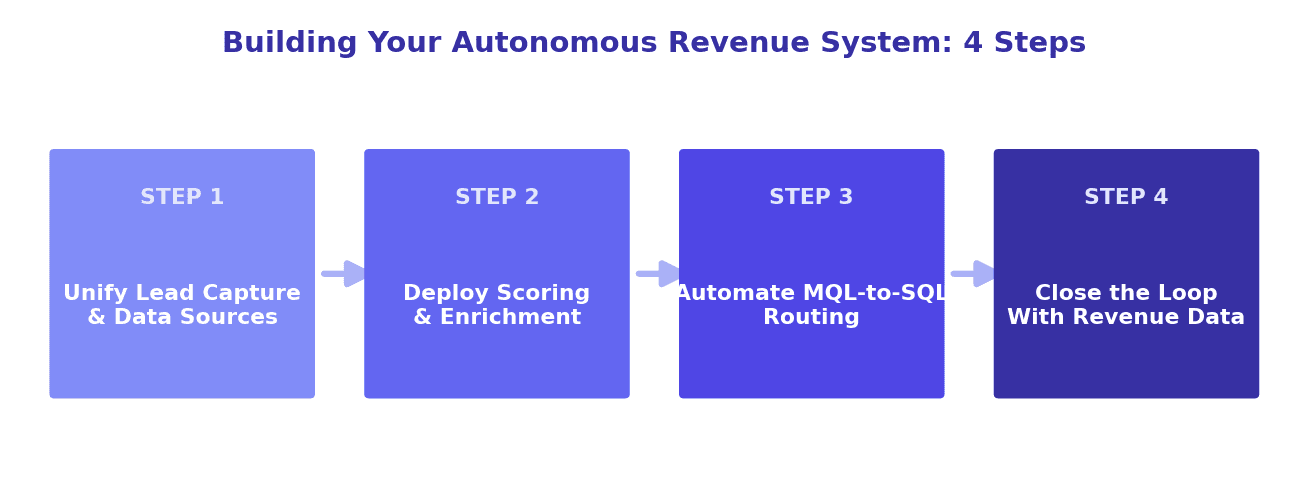
You can move to this model in phases. Follow these four steps.
Step 1: Unify Lead Capture and Data Sources
Bring every lead source, forms, chat, trials, events, and inbound email, into one pipeline with one data model. If leads enter through five disconnected tools, nothing downstream can work. This unification step is the foundation everything else stands on.
Step 2: Deploy Real-Time Scoring and Enrichment
Turn on instant enrichment so every lead becomes a complete profile at capture. Then implement real-time lead scoring using your historical conversion data as the training set. Start simple, with a model that separates clear buyers from clear non-buyers, and refine from there.
Step 3: Automate the MQL-to-SQL Hand-Off
Define your qualification threshold with sales, not just marketing. Then automate the routing: CRM record creation, rep assignment, and the context brief. Measure speed-to-first-touch before and after. This single step often cuts lead response time from days to minutes.
Step 4: Close the Loop With Revenue Data
Connect deal outcomes back to the scoring and routing system. This is the step most teams skip, and it is the one that makes the funnel self-optimizing. When revenue data flows backward, the system finally learns which leads, sources, and sequences actually make money.
The KPIs That Prove It Is Working
Measure the system on four numbers. Speed-to-first-touch: the time from lead capture to first sales contact, which should drop below five minutes for high-intent leads. MQL-to-SQL conversion rate: better scoring and routing should raise it steadily. Cost per SQL: as the funnel optimizes, you pay less for each genuinely qualified lead. And lead-to-revenue velocity: the total time from first touch to closed-won, which is the number your CFO actually cares about.
FAQ
What is an autonomous revenue system?
An autonomous revenue system is a connected pipeline that captures, enriches, scores, and routes leads automatically, then learns from closed revenue to improve itself. Instead of static forms and manual follow-up, the funnel reacts to buyer behavior in real time.
What is a self-optimizing funnel?
A self-optimizing funnel is a lead generation system that uses closed-won and closed-lost data to continuously retrain its lead scoring, routing rules, and follow-up sequences. Every deal outcome makes the next lead's journey smarter without manual reconfiguration.
How does real-time lead scoring work?
Real-time lead scoring evaluates a lead the moment it enters the system. It combines enriched firmographic data, behavioral signals like pricing page visits, and historical conversion patterns to assign a score instantly, so high-intent leads reach sales within minutes instead of days.
What is automated MQL-to-SQL routing?
Automated MQL-to-SQL routing uses scoring thresholds and intent triggers to move qualified leads from marketing to sales without human hand-offs. The system assigns the right rep, creates the CRM record, and delivers a context brief automatically, cutting response time from days to minutes.
Conclusion
Lead capture was never the goal. Revenue is. As long as your funnel ends at the form fill, you are collecting contacts while competitors are converting customers.
Autonomous revenue systems change the game: real-time lead scoring, instant enrichment, behavioral intent triggers, and automated MQL-to-SQL routing, all running on unified infrastructure that learns from every deal. Build the loop, close it with revenue data, and your funnel stops being a leaky pipeline. It becomes a system that optimizes itself, every single day.