
The Autonomous Enterprise: Building the Scalable Blueprint for Tomorrow’s Workforce
Where agentic automation is heading next, how teams and tech stacks need to change, and a phased roadmap to future-proof your business.
Most companies that experimented with AI agents in the last two years now have the same problem. They have a handful of useful agents, built by different teams, using different tools, with no shared way to find, govern or measure them. The pilots worked. The organisation around them did not change.
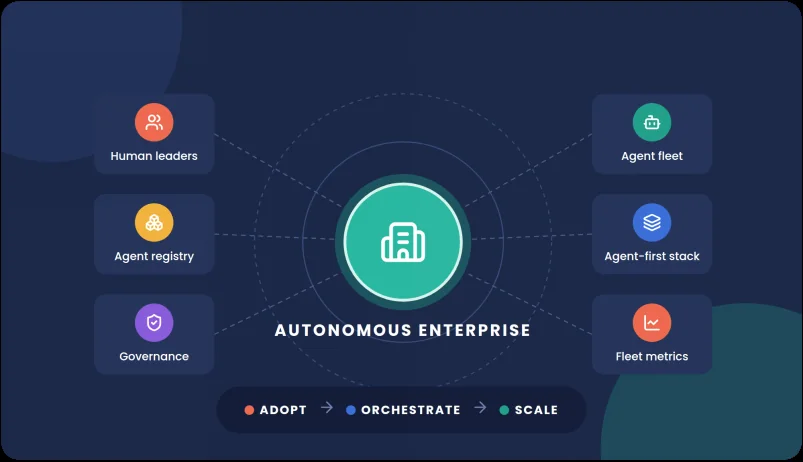
That gap is what an Autonomous Enterprise Blueprint is meant to close. It is not a single platform or a bold reorganisation. It is a deliberate plan for how people, agents, infrastructure and governance fit together, so that useful agents can be shared, trusted and scaled across departments instead of living as isolated experiments.
This is Part 8, the finale of our 8-part series "The Autonomous Enterprise". The earlier parts covered how agents work, how to connect them, how they recover from errors, how humans stay in control and how to measure ROI. This post brings those pieces together into one operating model, looks at the future of agentic AI over the next few years, and closes with a 3-year roadmap so you can adapt to your own business.
▬▬
What Is an Autonomous Enterprise?
An autonomous enterprise is an organisation where routine, multi-step work is increasingly planned and executed by AI agents, while people set goals, define guardrails, handle judgement calls and improve the system. It is not a company without employees. It is a company where the default question for repetitive work shifts from "who should do this?" to "which agent should do this, and who supervises it?"
| AI-enabled company Individual employees use AI tools to work faster. Gains are real but personal, uneven and hard to measure across the business. | Autonomous enterprise Agents are shared, governed business assets. Work is designed around human-agent teams, and the fleet is managed like any other capability. |
|---|
Each of these capabilities was introduced somewhere in the series. The blueprint simply makes them work together, which is where most of the long-term value of AI-first business transformation is likely to come from.
▬▬
The Autonomous Enterprise Blueprint: Six Building Blocks
The building blocks below are ordered roughly the way most organisations encounter them. You do not need all six on day one, but skipping one usually shows up later as duplicated agents, unclear ownership or costs nobody can explain.
1 The Hybrid Human-Agent Workforce
The most visible change is in what people actually spend their day doing. In a hybrid workforce, a marketing coordinator no longer builds every campaign list by hand. A research agent pulls the segment from HubSpot, a writing agent drafts the variants and a QA agent checks links and compliance language. The coordinator reviews, adjusts and approves.
The job moves from execution to delegation and supervision. That shift is the heart of how AI is reshaping the future workforce, and it is less about headcount than about where human attention goes: towards goals, exceptions, relationships and quality.
The same pattern applies elsewhere. In finance, an accounts payable specialist stops keying invoices and starts reviewing the small share an invoice-matching agent flags as uncertain. In sales operations, a rep spends less time updating Salesforce and more time on the conversations the CRM agent cannot have. The work that remains is often the more valuable and more human part of the job.
2 Managers as Agent Orchestrators
As teams become mixed, the manager role changes too. A support lead may oversee six people and a dozen agents: a triage agent, a refund agent, a knowledge-base agent and several others. Their job is to decide which work goes to which agent, set the confidence thresholds for human review and watch the fleet's performance alongside the team's.
This is the organisational side of the multi-agent orchestration patterns from Part 3, From Prompting to Delegating. The same hierarchical idea, a manager routing work to specialists,now applies to the org chart itself. A typical orchestration cycle for a manager looks like this:
Set goal → Assign agents → Define guardrails → Review exceptions → Measure outcomes → Refine
| Ownership is non-negotiable. Every production agent needs a named human owner who is accountable for its behaviour, its costs and its retirement. An agent without an owner is a risk, not an asset. |
|---|
3 Building an Internal Agent Registry
Once more than a few teams build agents, duplication starts quickly. Sales builds a lead-enrichment agent, marketing builds a slightly different one and finance builds a third for vendor checks. An internal agent registry solves this by acting as a catalogue where departments publish, discover and reuse agent skills.
Think of it as an internal app store with governance built in. Each entry describes what the agent does, which tools and data it can touch, who owns it and how well it performs. Many organisations will start with a simple shared database or service catalogue, then move to purpose-built tooling as the fleet grows.
| Registry field | What it records | Why it matters |
|---|---|---|
| Name and purpose | Plain-English job description | Helps teams find and reuse it |
| Owner | Accountable person and team | Clear responsibility |
| Tools and permissions | APIs, MCP servers, data scopes | Limits blast radius |
| Autonomy level | Suggest, approve or auto-execute | Sets HITL expectations |
| Model and version | LLM, prompt and config version | Reproducibility and rollback |
| Performance | Completion rate, error rate, cost per task | Evidence for scaling decisions |
| Status | Pilot, production or retired | Prevents zombie agents |
Open standards make a registry far more useful. The Model Context Protocol gives agents a common way to connect to tools and data, and agent-to-agent protocols such as A2A aim to let agents built on different frameworks describe their capabilities and hand work to each other. A registry built on these standards is easier to share across teams that use LangGraph, CrewAI or AutoGen.
A good registry also changes behaviour. Before building anything new, a team checks whether a suitable agent already exists, and if it nearly fits, they extend it instead of starting from scratch. Over time, the registry becomes a map of what the organisation can do autonomously, which is exactly the view leadership needs when planning where to invest next.
4 Moving to an Agent-First Infrastructure
Most enterprise systems were designed for humans clicking through screens. Agent-first infrastructure assumes that a growing share of interactions will come from software that reads documentation, calls APIs and needs clear, machine-readable rules. Part 4, Connecting the Dots, covered the integration layer in detail. At enterprise scale, that layer becomes a full stack.
An agent-first stack separates experience, orchestration, memory, tool access and governance, so each layer can evolve without rebuilding the others.
The shift is less about buying new products and more about changing defaults. The table below summarises what tends to change when an organisation moves from bolted-on AI to an agent-first approach.
| Area | Bolted-on AI | Agent-first |
|---|---|---|
| System access | Shared API keys in scripts | Scoped identities per agent |
| Integrations | One-off connectors per project | Reusable MCP servers and APIs |
| Knowledge | Documents copied into prompts | Governed retrieval with permissions |
| Approvals | Ad hoc messages | Standard HITL gates in Slack or Teams |
| Monitoring | Checked when something breaks | Fleet dashboards and alerts |
| Change control | Edits made in production | Versioned prompts and staged rollout |
5 Governance That Scales With the Fleet
Governance designed for five agents rarely survives fifty. Part 6, Human-in-the-Loop, described confidence thresholds, approval interfaces and audit trails for individual workflows. At enterprise scale, those controls need to become policies applied consistently, for example: any agent that can move money or edit customer master records must sit at an approval-required autonomy level, regardless of which team built it.
A central AI governance group, often with representatives from security, legal, data and the business, typically owns these policies. The registry then becomes the place where policy is enforced, because every agent's permissions and autonomy level are recorded there.
6 Measuring the Fleet, Not Just the Agent
Part 7, Measuring ROI, introduced unit economics and fleet KPIs. Scaling AI workforces adds one more question: is the portfolio of agents improving overall? Leaders should be able to see total autonomous throughput, cost per task across departments and which agents deserve more investment or retirement.
| Scale what is proven. Promote agents from pilot to shared registry asset only when their completion rate, error rate and cost per task are documented. Evidence, not enthusiasm, should drive scaling AI agents. |
|---|
▬▬
The Future of Agentic AI: What to Expect in the Next 2–3 Years
Predicting technology is risky, so treat this section as a set of reasonable expectations based on where the field is clearly moving in 2026, not as certainties. Timelines will vary by industry, regulation and budget. Still, a few directions look likely enough to plan around in any agentic strategy for 2026.
| ● Multimodal native execution Agents are expected to work directly with screens, documents, images, audio and video, not just text, making more legacy processes automatable. | ● Edge agents Smaller, efficient models will likely run on laptops, phones and on-site devices for low-latency or privacy-sensitive tasks. | |
|---|---|---|
| ● Self-improving workflows Agents may increasingly learn from logged corrections and evaluations, with humans approving changes before they go live. | ● Interoperability standards Protocols like MCP and A2A are likely to mature, making it easier to mix agents from different vendors. | |
| ● Agent identity and permissions Expect agents to get their own managed identities, credentials and audit trails, similar to employees and service accounts. | ● Falling cost per task If model efficiency keeps improving, more low-value tasks should become economical to automate. |
Multimodal native execution is the trend most likely to widen the scope of automation. Many business processes still run through scanned forms, screenshots, legacy desktop applications and recorded calls. Agents that can reliably read and act on those inputs would reach work that API-only automation has never touched, though they will also need tighter review gates, because acting on what an agent sees on a screen carries more room for error than calling a well-defined API.
Not all of these trends will arrive at the same speed or matter equally to every business. A simple way to prioritise is to map them by how soon they are likely to be practical and how much they could change your operations.
The common thread is that agents are expected to handle more kinds of work with less custom engineering. That makes the organisational blueprint more important, not less. The constraint on value will increasingly be how well a business can govern, share and measure agents, rather than whether the technology can do the task.
▬▬
The 3-Year Roadmap to an Autonomous Enterprise
A phased roadmap keeps ambition realistic. The three phases below, Adoption, Orchestration and Autonomous Scale, apply to both Fortune 500 companies and mid-market businesses. What changes is the pace and the amount of formal structure required.
STEP 1 Adoption: prove value safely
Choose a small number of repeatable, measurable workflows such as lead enrichment, invoice matching or support triage. Measure the baseline first, keep humans approving outputs and document what works.
STEP 2 Orchestration: connect and standardise
Stand up the agent registry, shared integrations and standard approval gates. Move proven single agents into coordinated multi-agent workflows and train managers to act as orchestrators.
STEP 3 Autonomous Scale: share and optimise
Open the registry across departments, report fleet-level ROI to leadership and raise autonomy levels only where performance data supports it. Retire agents that no longer earn their cost.
Each phase should end with a clear checkpoint rather than a date alone. Move from Adoption to Orchestration when several agents show stable, documented results and their owners are confident in the review process. Move to Autonomous Scale when the registry is in active use, governance policies are applied consistently and leadership can see fleet-level numbers without a manual reporting effort.
Size matters for how you run each phase. A multi-agent enterprise strategy at a global bank will look different from one at a 300-person software company, even if the phases are the same.
| Dimension | Fortune 500 enterprise | Mid-market business |
|---|---|---|
| Typical starting point | Many scattered pilots | One or two motivated teams |
| Governance | Formal AI council and policies | Lightweight owner and review rules |
| Agent registry | Dedicated platform with access controls | Shared catalogue or database |
| Integration focus | Legacy systems and ERP | SaaS tools like HubSpot and Slack |
| Main risk | Slow decisions and duplication | Key-person dependency |
| Likely pace | Closer to full 36 months | Phases may compress |
| Phases overlap. Teams will move at different speeds. It is normal for marketing to be in Orchestration while finance is still in Adoption, as long as both follow the same registry and governance rules. |
|---|
▬▬
Common Mistakes When Scaling AI Workforces
Most failures in a multi-agent organization are not technical. They come from skipping the organisational work that turns a good agent into a dependable business capability. Watch for these patterns:
| ✗ Scaling before measuring a baseline | ✗ Raising autonomy without evidence |
|---|---|
| ✗ Agents with no named owner | ✗ Ignoring change management and training |
| ✗ Every team building its own copy | ✗ Treating governance as a final step |
| ✗ Shared API keys across agents | ✗ Never retiring underperforming agents |
The fix for almost all of them is the same: a small set of shared rules, applied early and consistently, with a registry and metrics that make good behaviour the easy path.
▬▬
Series Recap: The Autonomous Enterprise in Eight Parts
This blueprint stands on the seven parts that came before it. Here is the key takeaway from each, so you can revisit the one most relevant to where your organisation is today.
| Part | Title | Key takeaway |
|---|---|---|
| 1 | The Agentic Shift | Agents pursue goals and adapt, where rule-based automation breaks |
| 2 | Deconstructing the AI Agent | Agents combine a reasoning core, memory and tools in a loop |
| 3 | From Prompting to Delegating | Specialised agent teams outperform single mega-prompts |
| 4 | Connecting the Dots | Structured outputs and scoped access protect enterprise systems |
| 5 | Self-Correction in Action | Reflection, retries and circuit breakers make agents resilient |
| 6 | Human-in-the-Loop | Confidence thresholds and audit trails keep humans in charge |
| 7 | Measuring ROI | Track cost per task, quality and speed, not just hours saved |
Put together, these parts describe a maturity path. Most organisations climb it one level at a time, and each level depends on the one beneath it.
Enterprise agent maturity builds step by step, from isolated experiments to a governed, shared and measured autonomous fleet.
▬▬
Conclusion
The autonomous enterprise is not a distant end state reserved for the largest companies. It is the practical result of decisions any business can start making now: give every agent an owner, publish agents in a shared registry, build on agent-first infrastructure, apply governance consistently and measure the fleet as a whole.
The technology will keep moving, and the future of agentic AI is likely to bring agents that see, hear and act across more systems with less custom work. Organisations that have already built the operating model around their agents will be best placed to absorb those advances safely. Those that have not may find themselves with more powerful tools and the same old pilot problem.
In simple words: agents do the work, people set the direction, and the blueprint is what lets both scale together.
▬▬
Frequently Asked Questions
What is an autonomous enterprise?
An autonomous enterprise is an organisation where AI agents plan and execute much of the routine, multi-step work, while people set goals, define guardrails and handle judgement calls. Agents are treated as shared, governed business assets rather than individual productivity tools.
What is an internal agent registry?
An agent registry is a central catalogue where teams publish, discover and reuse AI agents. Each entry records the agent's purpose, owner, tools and permissions, autonomy level, version and performance, which reduces duplication and makes governance enforceable.
How will AI agents change job roles?
Roles are expected to shift from executing every step to delegating work, reviewing agent output and handling exceptions. Managers increasingly act as orchestrators who assign work to both people and agents and are accountable for the results of each.
What trends will shape the future of agentic AI?
Likely trends over the next two to three years include multimodal native execution, edge agents running on local devices, self-improving workflows with human approval, maturing interoperability standards such as MCP and A2A, and managed identities for agents. These are expectations rather than certainties, and timelines will vary by industry.
How long does it take to become an autonomous enterprise?
A realistic roadmap spans around three years across three phases: Adoption, Orchestration and Autonomous Scale. Mid-market businesses can often move faster, while large enterprises usually need more time for governance, integration and change management.
Where should a company start with scaling AI agents?
Start with three to five repeatable, measurable workflows, record a baseline, keep humans approving outputs and give every agent a named owner. Once results are documented, add a shared registry and standard governance before expanding to more teams.
| The Autonomous Enterprise series. This is Part 8 of 8. Previous: Part 7, Measuring ROI: Key Metrics to Track Your Agentic Automation Fleet. |
|---|
▬▬
SEO Metadata and Schema Markup
Use the following metadata and JSON-LD schema when publishing this article. Replace the placeholder URLs, names, and images with your own before adding the script to the page head. The visible FAQ section above matches the FAQPage schema, which search engines require.
Metadata
Focus keyword: Autonomous Enterprise Blueprint
Secondary keywords: Future of Agentic AI, Scaling AI Workforces, Multi-Agent Enterprise Strategy, future workforce AI, scaling AI agents, multi-agent organization, agentic strategy 2026, AI-first business transformation, agent registry
SEO title (54 characters): Autonomous Enterprise Blueprint: Scaling AI Workforces
Meta description (155 characters): A practical autonomous enterprise blueprint: hybrid human-agent teams, an internal agent registry, agent-first infrastructure and a 3-year scaling roadmap.
URL slug: /autonomous-enterprise-blueprint
Series: The Autonomous Enterprise, Part 8 of 8
Word count: 2,900 (approx. 13 minute read)
Schema Markup (JSON-LD)
<script type="application/ld+json">

{

"@context": "https://schema.org",

"@graph": [

{

"@type": "BlogPosting",

"@id": "https://www.yourwebsite.com/blog/autonomous-enterprise-blueprint#article",

"mainEntityOfPage": {

"@type": "WebPage",

"@id": "https://www.yourwebsite.com/blog/autonomous-enterprise-blueprint"

},

"headline": "The Autonomous Enterprise: Building the Scalable Blueprint for Tomorrow’s Workforce",

"alternativeHeadline": "Where agentic automation is heading next, how teams and tech stacks need to change, and a phased roadmap to future-proof your business.",

"description": "A practical autonomous enterprise blueprint: hybrid human-agent teams, an internal agent registry, agent-first infrastructure and a 3-year scaling roadmap.",

"image": [

"https://www.yourwebsite.com/images/autonomous-enterprise-blueprint-hero.webp",

"https://www.yourwebsite.com/images/autonomous-enterprise-blueprint-the-autonomous-enterprise-operating-model.webp",

"https://www.yourwebsite.com/images/autonomous-enterprise-blueprint-how-job-roles-shift.webp",

"https://www.yourwebsite.com/images/autonomous-enterprise-blueprint-the-agent-first-enterprise-stack.webp",

"https://www.yourwebsite.com/images/autonomous-enterprise-blueprint-prioritising-agentic-ai-trends.webp",

"https://www.yourwebsite.com/images/autonomous-enterprise-blueprint-3-year-autonomous-enterprise-roadmap.webp",

"https://www.yourwebsite.com/images/autonomous-enterprise-blueprint-autonomous-enterprise-maturity-levels.webp"

],

"author": {

"@type": "Person",

"name": "Your Name",

"url": "https://www.yourwebsite.com/about"

},

"publisher": {

"@type": "Organization",

"name": "Your Company Name",

"logo": {

"@type": "ImageObject",

"url": "https://www.yourwebsite.com/images/logo.webp"

}

},

"datePublished": "2026-10-01",

"dateModified": "2026-10-01",

"inLanguage": "en",

"articleSection": "Agentic AI",

"wordCount": 2900,

"keywords": [

"Autonomous Enterprise Blueprint",

"Future of Agentic AI",

"Scaling AI Workforces",

"Multi-Agent Enterprise Strategy",

"future workforce AI",

"scaling AI agents",

"multi-agent organization",

"agentic strategy 2026",

"AI-first business transformation",

"agent registry"

],

"about": [

{

"@type": "Thing",

"name": "Agentic AI"

},

{

"@type": "Thing",

"name": "Enterprise architecture"

},

{

"@type": "Thing",

"name": "Future of work"

},

{

"@type": "Thing",

"name": "Digital transformation"

}

],

"isPartOf": {

"@type": "CreativeWorkSeries",

"@id": "https://www.yourwebsite.com/blog/series/autonomous-enterprise#series",

"name": "The Autonomous Enterprise: Agentic AI Workflows",

"url": "https://www.yourwebsite.com/blog/series/autonomous-enterprise"

},

"position": 8

},

{

"@type": "FAQPage",

"@id": "https://www.yourwebsite.com/blog/autonomous-enterprise-blueprint#faq",

"mainEntity": [

{

"@type": "Question",

"name": "What is an autonomous enterprise?",

"acceptedAnswer": {

"@type": "Answer",

"text": "An autonomous enterprise is an organisation where AI agents plan and execute much of the routine, multi-step work, while people set goals, define guardrails and handle judgement calls. Agents are treated as shared, governed business assets rather than individual productivity tools."

}

},

{

"@type": "Question",

"name": "What is an internal agent registry?",

"acceptedAnswer": {

"@type": "Answer",

"text": "An agent registry is a central catalogue where teams publish, discover and reuse AI agents. Each entry records the agent's purpose, owner, tools and permissions, autonomy level, version and performance, which reduces duplication and makes governance enforceable."

}

},

{

"@type": "Question",

"name": "How will AI agents change job roles?",

"acceptedAnswer": {

"@type": "Answer",

"text": "Roles are expected to shift from executing every step to delegating work, reviewing agent output and handling exceptions. Managers increasingly act as orchestrators who assign work to both people and agents and are accountable for the results of each."

}

},

{

"@type": "Question",

"name": "What trends will shape the future of agentic AI?",

"acceptedAnswer": {

"@type": "Answer",

"text": "Likely trends over the next two to three years include multimodal native execution, edge agents running on local devices, self-improving workflows with human approval, maturing interoperability standards such as MCP and A2A, and managed identities for agents. These are expectations rather than certainties, and timelines will vary by industry."

}

},

{

"@type": "Question",

"name": "How long does it take to become an autonomous enterprise?",

"acceptedAnswer": {

"@type": "Answer",

"text": "A realistic roadmap spans around three years across three phases: Adoption, Orchestration and Autonomous Scale. Mid-market businesses can often move faster, while large enterprises usually need more time for governance, integration and change management."

}

},

{

"@type": "Question",

"name": "Where should a company start with scaling AI agents?",

"acceptedAnswer": {

"@type": "Answer",

"text": "Start with three to five repeatable, measurable workflows, record a baseline, keep humans approving outputs and give every agent a named owner. Once results are documented, add a shared registry and standard governance before expanding to more teams."

}

}

]

},

{

"@type": "BreadcrumbList",

"@id": "https://www.yourwebsite.com/blog/autonomous-enterprise-blueprint#breadcrumb",

"itemListElement": [

{

"@type": "ListItem",

"position": 1,

"name": "Home",

"item": "https://www.yourwebsite.com"

},

{

"@type": "ListItem",

"position": 2,

"name": "Blog",

"item": "https://www.yourwebsite.com/blog"

},

{

"@type": "ListItem",

"position": 3,

"name": "The Autonomous Enterprise",

"item": "https://www.yourwebsite.com/blog/series/autonomous-enterprise"

},

{

"@type": "ListItem",

"position": 4,

"name": "The Autonomous Enterprise: Building the Scalable Blueprint for Tomorrow’s Workforce",

"item": "https://www.yourwebsite.com/blog/autonomous-enterprise-blueprint"

}

]

}

]

}

</script>