
By Sudha Venugopal, Head of AI Marketing Systems at Collide Solutions. Published 20 July 2026. Last updated 31 July 2026.
Most small businesses do not lose customers because the product is weak. They lose them because the follow-up was late. An enquiry arrives at 2:14 in the afternoon, nobody sees it until the next morning, and by the time someone calls on day two the buyer has already spoken to two competitors and made a decision.
In the AI systems we build for founders in Bengaluru and across India, this is the most common leak in the funnel, and it is the cheapest one to fix. This guide covers what AI marketing automation actually does, what separates it from the marketing automation you may already have tried, what it costs, and how to launch your first workflow in 30 days.
What is AI marketing automation?
AI marketing automation uses artificial intelligence inside marketing workflows to handle work that previously needed a person: scoring every inbound lead, drafting and sending follow-ups, moving ad budget toward what converts, and adapting the message to where someone is in the funnel.
Instead of a marketer deciding by hand who to contact next, the system ranks every lead the moment it arrives and triggers the right message on the right channel. Instead of guessing which creative works, it tests variations and shifts spend toward the winner. The result is a marketing engine that runs continuously and gets better with every interaction it records.
How it differs from the marketing automation you already know
This distinction matters, because many businesses tried rule-based automation years ago, found it rigid, and concluded automation does not suit them.
| Traditional marketing automation | AI marketing automation | |
|---|---|---|
| How decisions are made | Rules you write in advance | Judgement applied to each case |
| Handles messy input | Poorly, needs clean fields | Reads free text, voice notes, chat threads |
| Follow-up timing | Fixed schedule | Triggered by behaviour and intent |
| Message content | Templates with merge fields | Drafted for the specific lead, reviewed by a human |
| Lead prioritisation | Simple point scoring | Fit, intent and engagement combined |
| Fails when | Reality does not match your rules | Nobody reviews the exceptions |
The plumbing is the same in both. What changes is that the decisions are no longer limited to the rules somebody wrote in advance.
Why Indian businesses are adopting this faster in 2026
Rising acquisition costs. Paid channels have become more expensive, so wasting spend on poor targeting and slow follow-up costs more than it used to.
WhatsApp-first buyers. Indian customers increasingly expect a reply on WhatsApp within minutes. That is close to impossible to sustain manually across business hours, and it is straightforward to automate.
Team size constraints. A full in-house growth team is expensive to build and harder to retain. AI systems let a team of three cover ground that used to need eight.
The businesses adopting now are building a structural cost advantage over competitors still running everything by hand.
**The five parts of an AI marketing system
 **
**
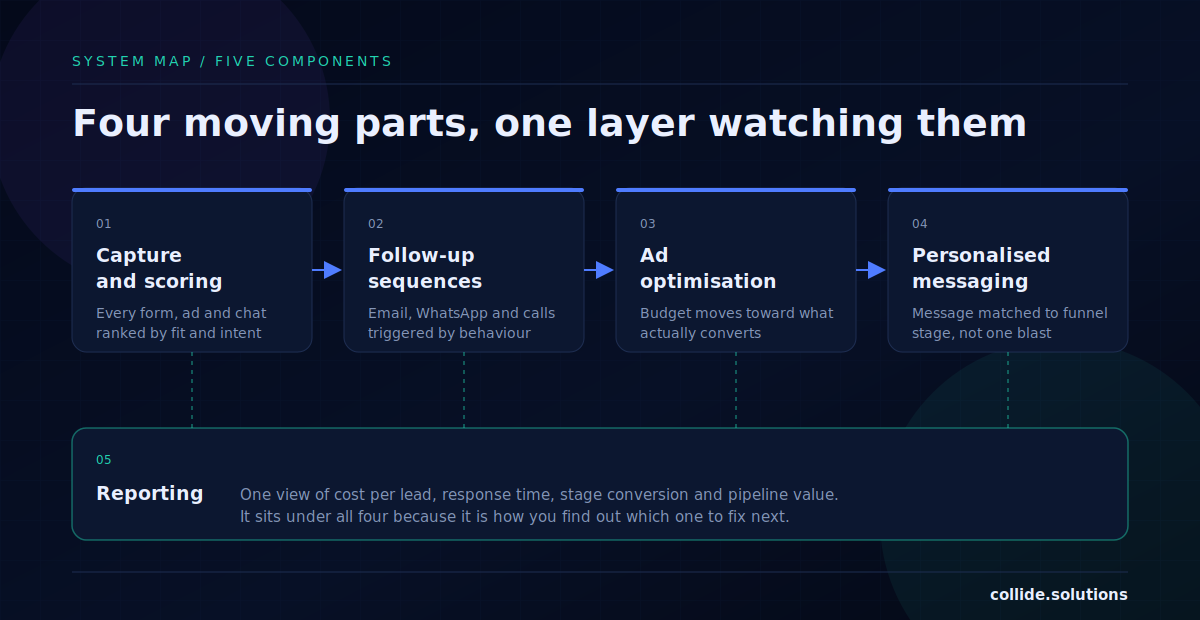
Lead capture and scoring. Every form, ad click, chat and call is captured, enriched, and ranked by how closely it resembles your best existing customers and how much intent it is showing.
Follow-up sequences. Email, WhatsApp and call tasks triggered by behaviour rather than a fixed calendar, and pausing the instant a human replies.
Ad optimisation. Continuous testing across creative and audience, with budget moving toward what actually produces qualified leads rather than cheap clicks.
Personalised messaging. Content matched to funnel stage, so a first-time visitor and someone who has read your pricing page three times do not get the same message.
Reporting. One view of cost per lead, response time, stage conversion and pipeline value. This sits underneath the other four, because it is how you find out which part to fix next.
**The funnel, stage by stage
 **
**
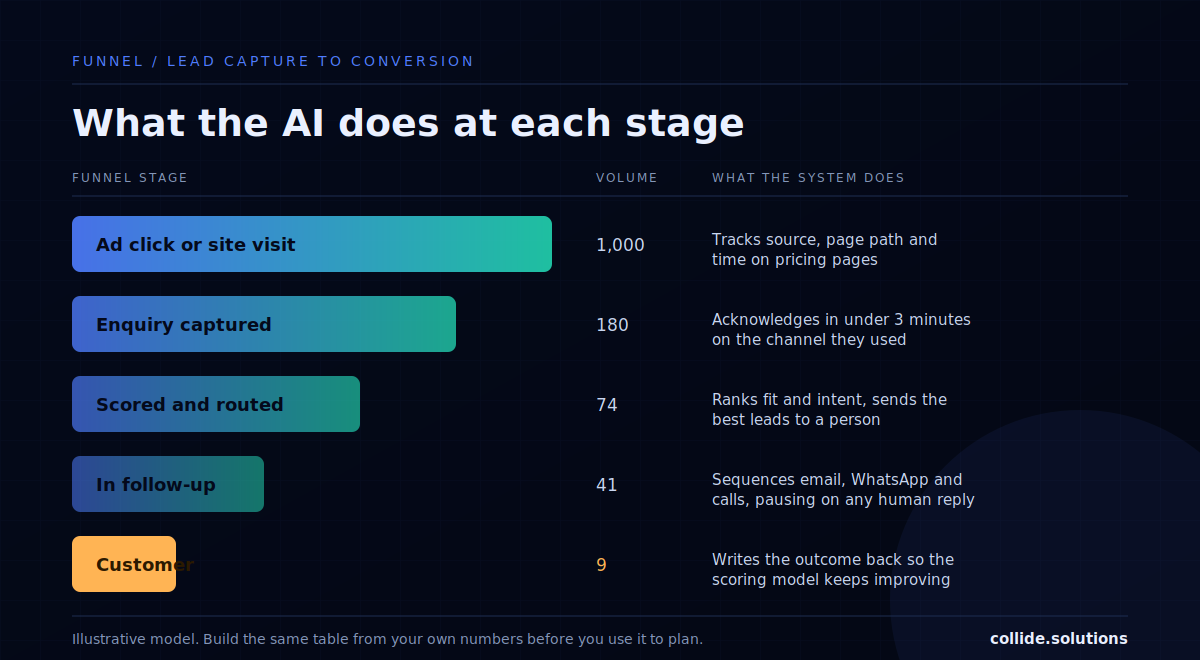
The value of a system becomes obvious when you look at where volume disappears. For an illustrative month:
| Stage | Volume | What the system does |
|---|---|---|
| Ad click or site visit | 1,000 | Tracks source, path and time on pricing pages |
| Enquiry captured | 180 | Acknowledges within three minutes on the channel used |
| Scored and routed | 74 | Ranks fit and intent, sends the best to a person |
| In follow-up | 41 | Sequences email, WhatsApp and calls, pausing on any reply |
| Customer | 9 | Writes the outcome back so scoring keeps improving |
Those numbers are a model, not a result from a client account. Build the same table from your own analytics before you plan against it. The diagnostic value is in the gaps: if enquiries are healthy but scored volume is low, your targeting is wrong. If follow-up volume is healthy but customers are few, the problem is your offer or your qualification, not your marketing.
What it costs and how long it takes
Indicative ranges for the Indian market, useful as a sanity check rather than a quotation. Scope, number of integrations and how clean your data is will move these considerably.
| Engagement | Typical timeline | What you should get |
|---|---|---|
| AI audit and roadmap | 1 to 2 weeks | Prioritised opportunities, baseline metrics, costed sequence |
| First workflow, such as instant enquiry response | 2 to 4 weeks | One live, documented, monitored workflow |
| Connected marketing system | 6 to 10 weeks | Capture, scoring, follow-up, personalisation, dashboards |
| Ongoing optimisation | Monthly | Improvements and reporting against agreed metrics |
Software licences are a separate line and should be quoted at cost. Ask any agency to show them to you directly.
Are you ready for it?
You do not need a large budget. You need a process that repeats. You are ready if any of these are true:
- Leads arrive but go cold before anyone replies
- Your team spends more time on manual admin than on strategy
- You have data in a CRM or even a spreadsheet, but nothing acts on it
- You want to handle more enquiries without hiring proportionally
If one of these applies, the right starting point is a single workflow, not a platform overhaul.
Five mistakes worth avoiding
- Automating a broken process. AI accelerates whatever you give it, including the inefficient version. Fix the process on paper first.
- Starting everywhere at once. Pick the workflow with the most friction, prove the return, then expand.
- Skipping integration. A system that does not write back to your CRM and ad accounts creates manual work rather than removing it.
- Nobody owning the exceptions. Automation that handles 80 percent and silently drops the rest is worse than none, because the drops stay invisible until a customer complains.
- No baseline. If you never measured response time before the build, you cannot prove the system worked, and it dies at the next budget review.
How to start in 30 days
Week 1. Measure your current lead response time and stage conversion. Pick one workflow. Week 2. Map it end to end, including what happens when the system is unsure and who reviews that queue. Week 3. Build and test it against real historical enquiries before it touches a live customer. Week 4. Launch with a human approving anything flagged, watch every case for two weeks, then expand.
How Collide Solutions approaches this
We build AI marketing systems on one principle: execution over theory. Engagements start with a free AI audit that finds where your funnel leaks, followed by a roadmap covering lead generation infrastructure, automation workflows and reporting, built to work with the tools you already run rather than replacing them.
We have applied this with businesses across design, wellness and B2B services, turning scattered tools into connected systems. Everything we build is documented and handed over in your own accounts, so the system remains yours.
Book a free AI audit and you will get a clear map of where your funnel is leaking and what each fix is worth, before anything gets built.
About the author. Sudha Venugopal leads AI Marketing Systems at Collide Solutions, where she designs lead generation and automation workflows for businesses across India and global markets. This article draws on direct implementation work from client projects and was reviewed by the Collide Solutions editorial team before publishing.
FAQ
What is AI marketing automation? It uses AI inside marketing workflows to handle work that previously needed a person: scoring leads, drafting and sending follow-ups, shifting ad budget, and personalising messages by funnel stage. Rule-based automation follows fixed steps, while AI automation reads unstructured input and makes a judgement before acting.
Is AI marketing automation affordable for small businesses in India? Yes, because these systems are modular. Start with one workflow such as instant enquiry response or WhatsApp follow-up, prove the return, and expand. The first workflow is usually a two to four week project rather than a platform purchase.
How long does it take to set up an AI marketing system? A single focused workflow is typically live within two to four weeks, depending on integration complexity. A connected system covering capture, scoring, follow-up and reporting usually runs six to ten weeks, staged so each phase delivers value before the next begins.
What should a small business automate first? Instant response to inbound enquiries, on the channel the enquiry arrived on. It is high frequency, needs little judgement, and directly affects conversion. Automating follow-up on unanswered quotations is usually second.
Does AI marketing automation replace a marketing team? It replaces tasks, not people. The system handles scoring, routing, sequencing and reporting. People keep offers, positioning, creative direction, relationships, and reviewing what the system produces.
What is the difference between marketing automation and AI marketing automation? Traditional automation executes rules written in advance. AI automation adds interpretation: it reads a messy enquiry, judges fit and intent, drafts a relevant reply and sets priority. Same plumbing, better decisions.